An overstay starts the day after the date stamped in your passport. In Thailand it costs 500 THB per day, up to a maximum of 20,000 THB, and a long overstay adds a ban on coming back of 1 to 10 years. Since the visa-free stay was cut to 30 days on 15 September 2026, more travellers are running past their stamp without meaning to. This guide sets out the fines and bans as the Immigration Bureau publishes them, what happens at the airport, and how to avoid an overstay altogether.
TL;DR
- The fine: 500 THB for each day over your permitted stay, capped at 20,000 THB, which you reach at 40 days.
- The ban: none if you leave and pay within 90 days; 1 to 10 years for longer overstays, and 5 to 10 years if you are arrested.
- How to avoid it: check the date in your entry stamp and, if you need more time, apply for the 30-day extension at an immigration office before that date (1,900 THB).
Thailand's overstay fine: 500 THB a day, 20,000 THB maximum
The Immigration Bureau sets the overstay fine at 500 THB per day, with a maximum of 20,000 THB. The Ministry of Foreign Affairs adds that the cap applies from 40 days of overstay. You pay it to immigration when you surrender, normally at the airport or border checkpoint as you leave.
| Days of overstay | Fine |
|---|---|
| 1 day | 500 THB |
| 3 days | 1,500 THB |
| 7 days | 3,500 THB |
| 14 days | 7,000 THB |
| 30 days | 15,000 THB |
| 40 days or more | 20,000 THB (maximum) |
Behind the administrative fine sits Section 81 of the Immigration Act B.E. 2522: staying without permission can be punished with up to 2 years in prison, a fine of up to 20,000 THB, or both, as the Board of Investment's immigration-law briefing%20%E0%B8%81%E0%B8%8F%E0%B8%AB%E0%B8%A1%E0%B8%B2%E0%B8%A2%E0%B8%87%E0%B8%B2%E0%B8%99%E0%B8%95%E0%B8%A3%E0%B8%A7%E0%B8%88%E0%B8%84%E0%B8%99%E0%B9%80%E0%B8%82%E0%B9%89%E0%B8%B2%E0%B9%80%E0%B8%A1%E0%B8%B7%E0%B8%AD%E0%B8%87%E0%B9%80%E0%B8%9A%E0%B8%B7%E0%B9%89%E0%B8%AD%E0%B8%87%E0%B8%95%E0%B9%89%E0%B8%99%2004032025.pdf) summarises.
Re-entry bans: surrender or arrest
The bans come from Ministry of Interior Order No. 1/2558, published in the Royal Gazette on 21 December 2015 and in force since 20 March 2016. What matters is how long you overstayed and whether you came forward yourself.
If you surrender and leave
| Overstay | Re-entry ban |
|---|---|
| Up to 90 days | No ban, fine only |
| More than 90 days | 1 year |
| More than 1 year | 3 years |
| More than 3 years | 5 years |
| More than 5 years | 10 years |
If you are arrested and prosecuted
| Overstay | Re-entry ban |
|---|---|
| 1 year or less | 5 years |
| More than 1 year | 10 years |
Every ban runs from the day you leave Thailand. The order does not apply to travellers who leave before their 18th birthday, so children are not banned. An arrest is the expensive route: even a short overstay discovered at a police check can turn into a 5-year ban, while the same overstay reported at departure costs only the fine.
Overstays in the 30-day visa-exempt era
From 15 September 2026, the revised visa-exemption scheme replaced the 60-day exemption: citizens of 60 countries and territories, including the UK, the USA, India and most of Europe, now get 30 days for tourism. Travellers used to the old 60-day stamp are the ones most likely to overstay now.
- Go by the stamp, not by your own count. The officer writes your last permitted day in the entry stamp. If you arrive on 1 December, check the exact date; it is around 30 December, not at the end of January.
- Your flight is not your permission. A return flight on day 35 means 5 days of overstay unless you extend.
- Leaving resets the clock, within limits. A new entry gives a new stamp, but back-to-back visa-free entries can attract questions at the counter. See the 30-day rules in detail.
How to avoid an overstay: the 30-day extension
The Royal Thai Embassy in Brussels confirms that the 30-day visa exemption can be extended by 30 more days at Thai immigration. The Immigration Bureau lists what you need for a tourism extension:
| What to bring | Detail |
|---|---|
| Form TM.7 | Filed in person at the immigration office for the area where you stay |
| Passport and a copy | With copies of the photo page and your latest entry stamp |
| Photo | 4 x 6 cm, taken within the last 6 months |
| Fee | 1,900 THB |
| Overstay acknowledgement | A signed form on overstay penalties, provided by the office |
- Apply before the date in your stamp. The day after it, you are already in overstay.
- Go to the office that covers your address, as the Public Handbook requires.
- Expect a decision at the officer's discretion. Under the bureau's rules, citizens of India, Sri Lanka, Pakistan, Bangladesh, Iran, Nepal, Togo, Nigeria and Uganda are limited to 7 extra days.
- Check the new stamp before you leave the counter, and plan your flight around it.
If you cannot extend, the alternative is simple: book a flight that leaves on or before the date in your stamp.
Coming back to Thailand? Start with a correct TDAC
Every new entry needs a new Thailand Digital Arrival Card. We check your details against your passport, file inside the 3-day window and email you the QR code.
Start TDAC ApplicationWhat happens at the airport if you have overstayed
The process is set out on the government's public-service portal:
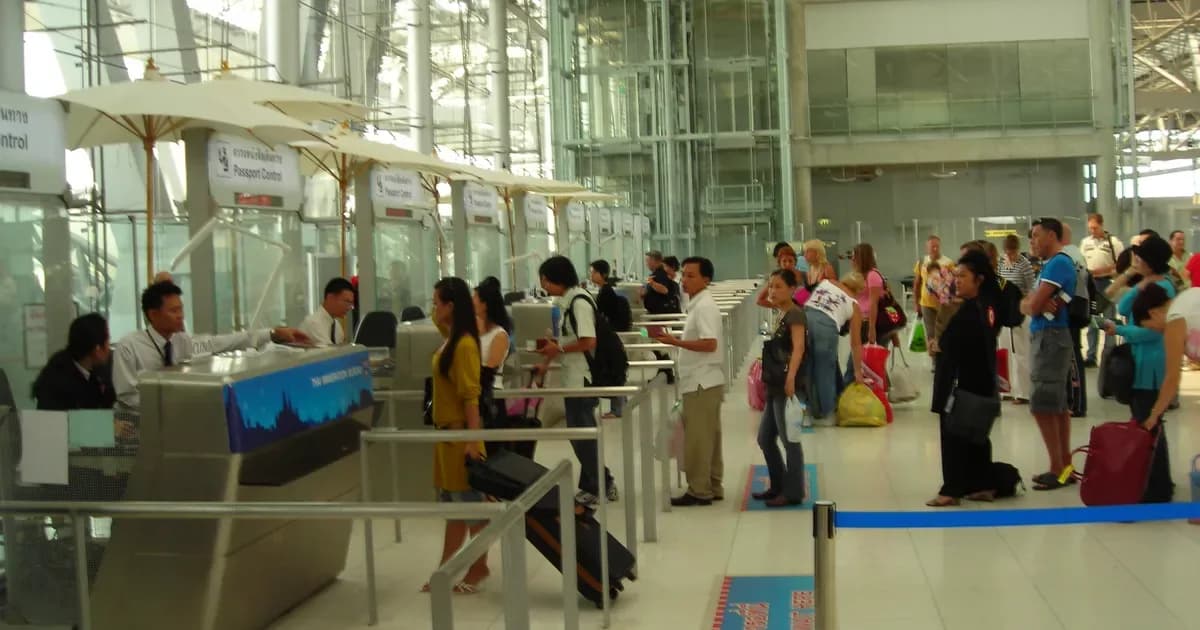
- At passport control the officer sees the overstay and sends you to the fines desk.
- An officer tells you the number of days and the amount.
- You pay, receive a receipt, and your passport is stamped and returned.
- If you do not agree to pay, the officer opens a further investigation.
Allow extra time at the airport, keep enough baht to pay, and have your boarding pass ready. If you have overstayed more than 90 days, the re-entry ban starts on the day you leave. The Royal Thai Embassy in Bucharest says an overstay of a few hours, for example after a late flight, is usually waived, but you should not rely on it.
Special cases
- Cancelled flights and emergencies. The bureau can waive fines by announcement. In March 2026 it waived overstay fines for travellers whose stay expired from 28 February 2026 and who could not leave because of Middle East airspace closures. Without such an announcement, the normal fine applies.
- Hospital stays. The Immigration Bureau has a separate extension route for medical treatment, with a letter from the hospital's physician.
- Children. Every traveller, babies included, has their own permitted stay in their own passport. The re-entry ban does not apply to anyone who leaves before turning 18.
- New or lost passport. Your permission to stay is in the old passport. If you are only leaving, show both passports at departure; to extend, have the stamp transferred first, as Immigration Division 1 explains.
Your next trip after an overstay
If you paid a fine for fewer than 90 days and left, no ban applies and you can come back. Each new entry needs a new Thailand Digital Arrival Card, and officers may ask about your previous stay, so carry your return ticket and accommodation details. Our guide to entry refusal red flags explains what officers look for.
Frequently asked questions
What happens if I overstay in Thailand by 1 day?
What is the maximum overstay fine in Thailand?
Where do I pay the overstay fine?
Will I be banned for an overstay of less than 90 days?
Can I extend my stay after I have already overstayed?
How much does the 30-day extension cost?
Do children get banned for overstaying?
Are overstay fines waived if my flight is cancelled?
Official sources
- Immigration Division 1: FAQ, rate of overstay fine and penalty
- Ministry of Interior Order No. 1/2558, Royal Gazette, 21 December 2015
- Ministry of Foreign Affairs: note No. 0404/C.1021 on overstay
- Board of Investment: immigration laws foreign nationals must know%20%E0%B8%81%E0%B8%8F%E0%B8%AB%E0%B8%A1%E0%B8%B2%E0%B8%A2%E0%B8%87%E0%B8%B2%E0%B8%99%E0%B8%95%E0%B8%A3%E0%B8%A7%E0%B8%88%E0%B8%84%E0%B8%99%E0%B9%80%E0%B8%82%E0%B9%89%E0%B8%B2%E0%B9%80%E0%B8%A1%E0%B8%B7%E0%B8%AD%E0%B8%87%E0%B9%80%E0%B8%9A%E0%B8%B7%E0%B9%89%E0%B8%AD%E0%B8%87%E0%B8%95%E0%B9%89%E0%B8%99%2004032025.pdf)
- Thailand.go.th: how overstay fines are imposed
- Government Public Relations Department: revision of the visa exemption and Visa on Arrival schemes, 4 September 2026
- Ministry of Foreign Affairs, Department of Consular Affairs: 30-day visa exemption list, 15 September 2026
- Royal Thai Embassy, Brussels: visa exemption
- Immigration Bureau: visa extension
- Immigration Bureau: Public Handbook 2.4, extension of stay for tourism
- Royal Thai Embassy, Bucharest: overstaying in Thailand
- Government Public Relations Department: overstay fines waived for travellers affected by Middle East airspace closures, 4 March 2026
Related guides
- Thailand visa and entry rules 2026
- Thailand's 30-day visa exemption explained
- Denied entry to Thailand: red flags
- THIM vs TDAC
- TDAC guide
TDAC.info is an independent service and is not affiliated with the Thai Government or the Immigration Bureau. We checked the official sources on 23 November 2026.
Coming back to Thailand? Start with a correct TDAC
Every new entry needs a new Thailand Digital Arrival Card. We check your details against your passport, file inside the 3-day window and email you the QR code.
Start TDAC ApplicationReviewed by
Jason Hartley
Travel Documentation Specialist · TDAC.info
Last reviewed on
Fact-checked against the official Thai Immigration Bureau guidance.