
Notes from Jason Hartley
Patterns we see most often when verifying applications
- Visa-free entry does NOT exempt you from filing a TDAC — every passport holder needs both, no matter the visa class.
- Proof of onward travel is checked more strictly at land borders than at airports — bring a printed itinerary either way.
- Since 15 September 2026 the visa exemption gives 30 days to nationals of 60 countries and territories.
In force since 15 September 2026: the visa-free stay is 30 days
Thailand's Royal Gazette published the new visa-exemption framework on 31 August 2026 and it took effect on 15 September 2026. The standard visa-free stay is now 30 days for 60 countries and territories, not 60 days for 93. Travellers who arrived up to and including 14 September 2026 keep the 60-day stamp they were given. Anything below that refers to a 60-day stay describes the rules before 15 September. Full detail in our Royal Gazette report and the country-by-country visa page.
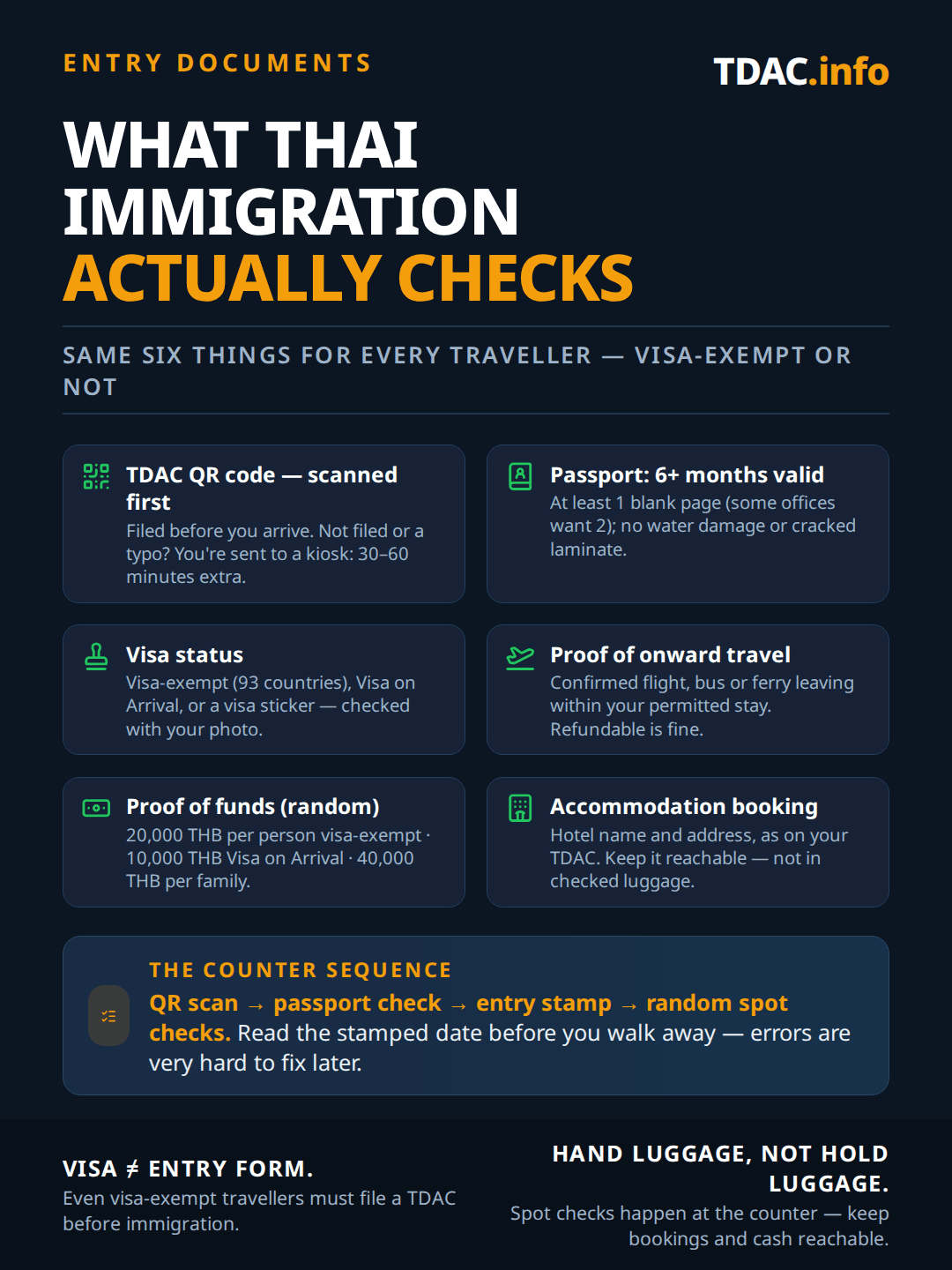
Your visa status only determines how long you can stay. But regardless of visa type, every traveler must present the same set of documents at the immigration counter. This guide covers the mandatory entry requirements for Thailand in 2026 — including the TDAC digital arrival card that trips up more travelers than anything else.
WHAT IMMIGRATION CHECKS
The #1 Mistake Travelers Make
Visa ≠ Entry Form. Even if you do not need a visa (60 countries and territories are visa-exempt from 15 September 2026), you MUST still file a Thailand Digital Arrival Card (TDAC) before you clear immigration. These are two completely separate requirements. Without a TDAC, you will be sent to a kiosk at the airport to fill it in before you can be processed.
How long is the visa-free stay now?
Thailand's visa-free stay dropped from 60 days to 30 days on 15 September 2026, for a list cut from 93 countries to 60. For the deep dive — who qualifies, how to extend to 60 days, what the dropped countries fall back on, and the land-border two-entries-per-year cap — see Thailand 30 Day vs 60 Day Visa Exemption.
1. The Thailand Digital Arrival Card (TDAC)
The TDAC is a mandatory digital form for every foreign national entering Thailand. It replaced the old paper TM.6 arrival card. You must complete it before you arrive — immigration officers will scan your QR code at the counter.
What the TDAC Collects
- Passport data: Full name (exactly as printed in your MRZ line), nationality, passport number, date of birth, expiry date.
- Flight information: Airline, flight number, date of arrival.
- Accommodation in Thailand: Hotel name and address, or your host's address if staying privately.
- Purpose of visit: Tourism, business, transit, or other.
How to File
- When: The portal accepts your TDAC from 72 hours before arrival. Book with us up to 12 months ahead; we file as soon as the window opens.
- Where: The official government portal (free) or through an assisted filing service like TDAC.info (with error review).
- Output: A QR code delivered to your email. Save it on your phone and print a backup copy.
Common TDAC Rejection Reasons
Passport number typo: The most common error. One wrong digit and your QR code will not match at the counter.
Name mismatch: Your TDAC name must exactly match the MRZ line in your passport (not your preferred name).
Wrong date format: Confusing DD/MM/YYYY with MM/DD/YYYY causes mismatched arrival dates.
Missing accommodation: You must provide a Thai address — 'traveling around' is not accepted.
For step-by-step fixes, see our TDAC troubleshooting guide. To prepare your documents before filing, use our TDAC checklist.
2. Passport Requirements
Your passport must meet two non-negotiable conditions — fail either one and you will be denied boarding or entry:
- 6-month validity rule: Your passport must have at least 6 months of validity remaining from your date of entry into Thailand. Airlines enforce this at check-in — if your passport expires within 6 months, you will not be allowed to board.
- Blank visa pages: You need at least 1 blank page for the entry stamp. Some immigration offices require 2 blank pages.
- Damaged passport: A cracked laminate, water damage, or illegible pages can result in denial at the immigration counter. If in doubt, renew before you travel.
3. Proof of Onward Travel
Immigration officers can ask for proof that you plan to leave Thailand within your permitted stay. This is enforced more strictly for:
- Solo travelers arriving on one-way tickets
- Travelers using Visa on Arrival (VOA)
- Anyone who has been flagged for previous overstays or repeated visa-exempt entries
What counts: A confirmed flight booking, bus ticket to a neighbouring country, or ferry ticket. The booking must show departure within your permitted stay — 30 days for most visa-exempt travellers from 15 September 2026, 15 days on a visa on arrival. Flexible and refundable bookings are fine; they just need to exist when the officer asks.
4. Proof of Funds
Thailand requires proof of sufficient funds for your stay. The amounts are:
| Entry Type | Required Amount | Notes |
|---|---|---|
| Visa-Exempt (30 days) | 20,000 THB (~$600 USD) per person | Cash preferred; bank statement also accepted |
| Visa on Arrival | 10,000 THB (~$300 USD) per person | Cash only at VOA counter |
| Tourist Visa (TR) | 20,000 THB per person | Cash or bank statement |
| Family/Group | 40,000 THB per family | Regardless of family size |
How it works in practice: Spot checks are random, not universal. You are more likely to be checked if you are traveling solo, arriving on a one-way ticket, have limited stamps in your passport, or if the immigration officer has any reason to question your trip. Carry the cash anyway — being caught without it means denied entry.
5. What Immigration Officers Actually Check
The officer scans your TDAC QR code first, then checks your passport validity and visa status, stamps your entry, and may randomly ask for proof of funds or onward travel. Here is the full sequence so you can prepare everything in advance:
TDAC QR Code Scan
The officer scans your QR code first. If it fails (typo, expired, not filed), you are sent to a kiosk to file on the spot. This adds 30-60 minutes.
Passport Check
They verify your identity photo, check passport validity (6+ months), and confirm your visa status (exempt, VOA, or visa sticker).
Entry Stamp
You receive a stamp with your permitted stay duration. Check the date immediately — errors happen and are very difficult to fix later.
Spot Checks (Random)
Some travelers are asked for proof of onward travel, accommodation booking, or proof of funds. Have these accessible — not buried in your checked luggage.
6. Overstay Rules & Penalties
If you stay past the date stamped in your passport, you are officially on "overstay." Penalties escalate fast:
| Overstay Duration | Penalty | Consequence |
|---|---|---|
| 1-90 days | 500 THB per day (max 20,000 THB) | Fine paid at airport departure; no ban if voluntary |
| 91 days - 1 year | 20,000 THB fine | 1-year re-entry ban |
| 1-3 years | 20,000 THB fine | 3-year re-entry ban |
| 3-5 years | 20,000 THB fine | 5-year re-entry ban |
| 5+ years | 20,000 THB fine | 10-year re-entry ban |
| Caught by police (any duration) | Arrest + deportation | 5-year ban + criminal record |
Voluntary vs. Caught
If you voluntarily report your overstay at the airport when leaving, penalties are milder (fine only, shorter bans). If you are caught by police during a random check, raid, or traffic stop, the consequences are much worse — arrest, detention, deportation, and a 5-year ban regardless of overstay duration.
7. Special Cases
Children & Infants
Every child — including infants — needs their own passport, their own TDAC filing, and their own entry stamp. There is no exemption for minors. For the occupation field on the TDAC, select Child for every traveller under 18 — infants included; 'Student' is only for enrolled university students.
Transit Passengers
If you are transiting through Thailand (connecting flights within the same terminal), you do not need a TDAC or visa. However, if your transit requires you to exit the secure area, re-check luggage, or change terminals, you must clear immigration — which means you need both a TDAC and appropriate visa status.
Land Border Entries
Visa-exempt travellers entering by land (from Malaysia, Laos or Myanmar — the Cambodian crossings are currently closed) receive the same 30-day stamp as air arrivals from 15 September 2026. Land entries remain limited to 2 per calendar year, except for citizens of Malaysia, Brunei, Indonesia and Singapore, who are exempt from that cap. Air entries have no annual limit.
Thailand–Cambodia Border: Closed to Overland Travel
Every land crossing between Thailand and Cambodia — including the routes most travellers used, Aranyaprathet–Poipet and Hat Lek–Cham Yeam — is closed. The crossings shut during the 2025 border conflict and, although a ceasefire was agreed on 27 December 2025, they had still not reopened as of July 2026. Thai authorities have also barred tourists from crossing into Cambodia by land. Do not plan an overland Thailand–Cambodia leg, and do not count on a Cambodian border run to reset a visa-exempt stay.
Travel between the two countries is only possible by air. Bangkok to Phnom Penh and Bangkok to Siem Reap flights operate normally, and you will need a new TDAC for the Thailand leg of any such trip, exactly as with any other arrival by air.
If your route assumed a Cambodian land crossing
Rebook the leg as a flight and file a fresh TDAC for your return to Thailand. Areas immediately around the border remain subject to unexploded ordnance and sudden exclusion zones, so avoid them even where roads are open. Major destinations — Bangkok, Chiang Mai, Phuket — are entirely unaffected. We track the reopening and update this page when the checkpoints change status. Filing for your flight back in? Start your TDAC application.
Check your visa status
Not sure which visa applies to your nationality? Use our Thailand Visa Checker or see the complete country-by-country visa list.
New: DTV application rules changed on 31 August 2026
Destination Thailand Visa applicants must now be a national or permanent resident of the country where they apply, and must provide a criminal record certificate. Applications submitted and paid before 31 August 2026 are unaffected. Read what changed and who it affects.
Ready to file your TDAC?
The TDAC is mandatory for every traveler. Let our experts review your data and catch errors before they cause problems at the immigration counter.
Start TDAC ApplicationReviewed by
Jason Hartley
Travel Documentation Specialist · TDAC.info
Last reviewed on
Fact-checked against the official Thai Immigration Bureau guidance.