
In force since 15 September 2026: the visa-free stay is 30 days
Thailand's Royal Gazette published the new visa-exemption framework on 31 August 2026 and it took effect on 15 September 2026. The standard visa-free stay is now 30 days for 60 countries and territories, not 60 days for 93. Travellers who arrived up to and including 14 September 2026 keep the 60-day stamp they were given. Anything below that refers to a 60-day stay describes the rules before 15 September. Full detail in our Royal Gazette report and the country-by-country visa page.
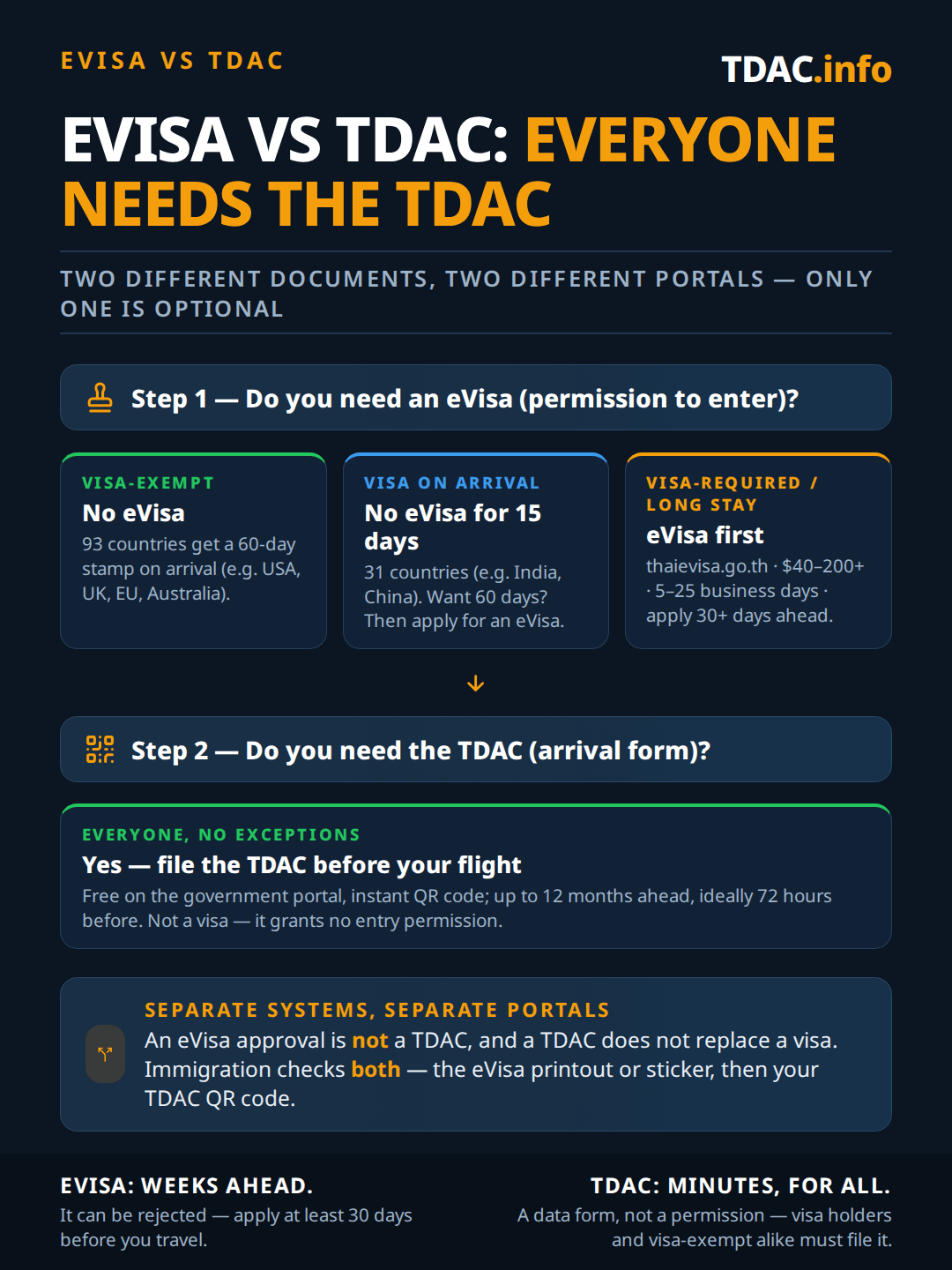
If you are planning a trip to Thailand in 2026, you have probably seen two terms thrown around: eVisa and TDAC. They sound similar, they are both online, and they both relate to entering Thailand — but they are completely different documents with different purposes. Filing the wrong one (or skipping the one you actually need) can cause serious problems at immigration. This guide breaks down exactly what each one is, who needs which, and whether you need both.
EVISA VS TDAC
TDAC (Digital Arrival Card)
Purpose: Immigration arrival form
Who needs it: ALL foreign travelers
Cost: Free (gov) / $29 (assisted)
Processing: Instant — QR code in minutes
Validity: Single entry
eVisa (Electronic Visa)
Purpose: Permission to enter Thailand
Who needs it: Only visa-required nationalities
Cost: $40–$200+ depending on visa type
Processing: 5–25 business days
Validity: Varies (single/multiple entry)
What Is the Thailand eVisa?
The Thailand eVisa (Electronic Visa) is a digital visa issued through the official Thai government portal at thaievisa.go.th. It replaced the old process of visiting a Thai embassy or consulate in person for many visa types.
An eVisa is a permission to enter Thailand. It is required for citizens of countries that do not qualify for visa-free entry or visa on arrival. Without it, you will be denied boarding at the airline check-in counter — you will never even reach Thai immigration.
Common eVisa types include:
- Tourist Visa (TR): For citizens of visa-required countries planning a holiday in Thailand. Single or multiple entry, valid for 60 days per entry.
- Non-Immigrant Visa (various categories): For work (B), education (ED), retirement (O), or volunteering. Requires supporting documents like employment letters or school enrollment.
- Destination Thailand Visa (DTV): The digital nomad visa. Costs 10,000 THB, valid for 5 years with 180-day entries. Must apply from outside Thailand.
- Transit Visa (TS): For travelers connecting through Thailand to a third country. Valid for 30 days.
Key Point
The eVisa application process takes 5 to 25 business days. You must apply well before your departure date. Required documents typically include passport photos, flight itineraries, hotel bookings, bank statements, and sometimes an interview at a Thai embassy.
What Is the TDAC (Thailand Digital Arrival Card)?
The TDAC (Thailand Digital Arrival Card) is an immigration arrival form — not a visa. It replaced the old paper-based TM.6 departure/arrival card that travelers used to fill out on the plane.
Every foreign national entering Thailand must complete the TDAC, regardless of nationality, visa type, or purpose of visit. It collects basic information like your passport details, flight number, accommodation address in Thailand, and travel purpose.
The TDAC is not a permission to enter Thailand. It is an administrative form that feeds data to the Thai immigration system. Think of it as a digital customs declaration combined with an arrival notification.
- Who needs it: Every foreign traveler, no exceptions. Visa holders, visa-exempt travelers, and visa-on-arrival travelers all need a TDAC.
- Processing time: Instant. You receive a QR code immediately after submission.
- When to file: Up to 12 months before arrival, or at least 72 hours before your flight for peace of mind.
- What you get: A QR code that you present at the immigration counter alongside your passport.
Side-by-Side Comparison
| Feature | Thailand eVisa | TDAC |
|---|---|---|
| What is it? | A visa (permission to enter) | An arrival form (immigration data) |
| Mandatory for everyone? | No — only visa-required nationalities | Yes — ALL foreign travelers |
| Cost | $40–$200+ (government fee) | Free via government portal |
| Processing time | 5–25 business days | Instant (QR code in minutes) |
| Where to apply | thaievisa.go.th | tdac.immigration.go.th or assisted services |
| Documents needed | Passport, photos, bank statements, itinerary | Passport, flight number, hotel address |
| Validity | Single or multiple entry (varies by type) | Single entry |
| Can you be denied? | Yes — applications can be rejected | No — it is a data submission form |
| Replaces | Embassy visa appointments | Paper TM.6 arrival/departure card |
Do You Need Both?
The Golden Rule
Everyone needs a TDAC. Not everyone needs an eVisa.
If your nationality qualifies for visa-free entry (60 countries get 30 days from 15 September 2026), for a bilateral treaty stay (90, 30 or 14 days for countries dropped from the list) or for visa on arrival (Azerbaijan, Belarus and Serbia get 15 days), you do not need an eVisa. But you still must file a TDAC.
If your nationality is on none of those lists, you need both: an eVisa to enter and a TDAC to be processed at the counter.
Which One Do You Need?
Here are the three most common scenarios for travelers arriving in Thailand in 2026:
Tourist from a Visa-Exempt Country
e.g., USA, UK, EU, Australia
You do NOT need an eVisa. You receive a 30-day stamp on arrival, extendable once by 30 days for 1,900 THB. You MUST still complete the TDAC before your flight — without it you face delays at immigration.
Tourist From a Dropped Country
e.g., South Korea, China, Russia, Brazil
Your country is off the exemption list but keeps its bilateral treaty with Thailand — 90 days for South Korea and Brazil, 30 for China and Russia. No eVisa needed for a stay inside that limit. The TDAC is still mandatory.
Tourist Needing a Visa
e.g., Mexico, Uzbekistan, Sri Lanka
From 15 September 2026 these passports have no exemption and no visa on arrival. Apply for a Tourist Visa through thaievisa.go.th before you fly, allow 5-25 business days, and file the TDAC as well. Airlines will deny boarding without the visa.
Common Mistakes to Avoid
- Confusing TDAC with eVisa: Some travelers apply for an eVisa thinking it replaces the TDAC. It does not. They are separate systems with separate portals.
- Skipping the TDAC because you have a visa: Even if you hold a valid Thai visa (eVisa, sticker visa, or visa on arrival), you still need to file the TDAC. Immigration officers check both.
- Applying for an eVisa when you don’t need one: Citizens of visa-exempt countries (USA, UK, most of the EU, Australia, etc.) do not need any visa for stays up to 60 days. Applying for an eVisa wastes time and money.
- Last-minute eVisa applications: Unlike the TDAC (which is instant), eVisas take days or weeks to process. Apply at least 30 days before your travel date.
- Using unofficial eVisa websites: The only legitimate eVisa portal is thaievisa.go.th. Unofficial websites charge inflated fees and may never deliver a real visa.
What Happens at the Immigration Counter?
When you reach the immigration desk at Suvarnabhumi, Don Mueang, Phuket, or any Thai airport, the officer will check:
- Your passport — valid for at least 6 months, with blank pages for stamps.
- Your visa (if required) — eVisa approval printout or visa sticker in passport.
- Your TDAC QR code — scanned at the counter. If you do not have one, you may be sent to a kiosk to fill it out on the spot (expect 30+ minute delays).
- Proof of onward travel — a flight booking leaving Thailand within your permitted stay.
- Proof of funds (random checks) — 20,000 THB cash per person.
Can I use my eVisa approval as my TDAC?
I'm from the US/UK/EU. Do I need an eVisa?
How much does the TDAC cost vs the eVisa?
I applied for the wrong one. What do I do?
Is the TDAC the same as the old TM.6 arrival card?
Not sure which visa you need?
Use our free Thailand Visa Checker — answer 3 quick questions and get a personalized recommendation in seconds.
Need to file your TDAC? We make it simple.
Our assisted filing service reviews your passport data, catches common errors, and delivers your QR code in minutes. No confusing government portals, no guesswork.
Start TDAC ApplicationReviewed by
Jason Hartley
Travel Documentation Specialist · TDAC.info
Last reviewed on
Fact-checked against the official Thai Immigration Bureau guidance.