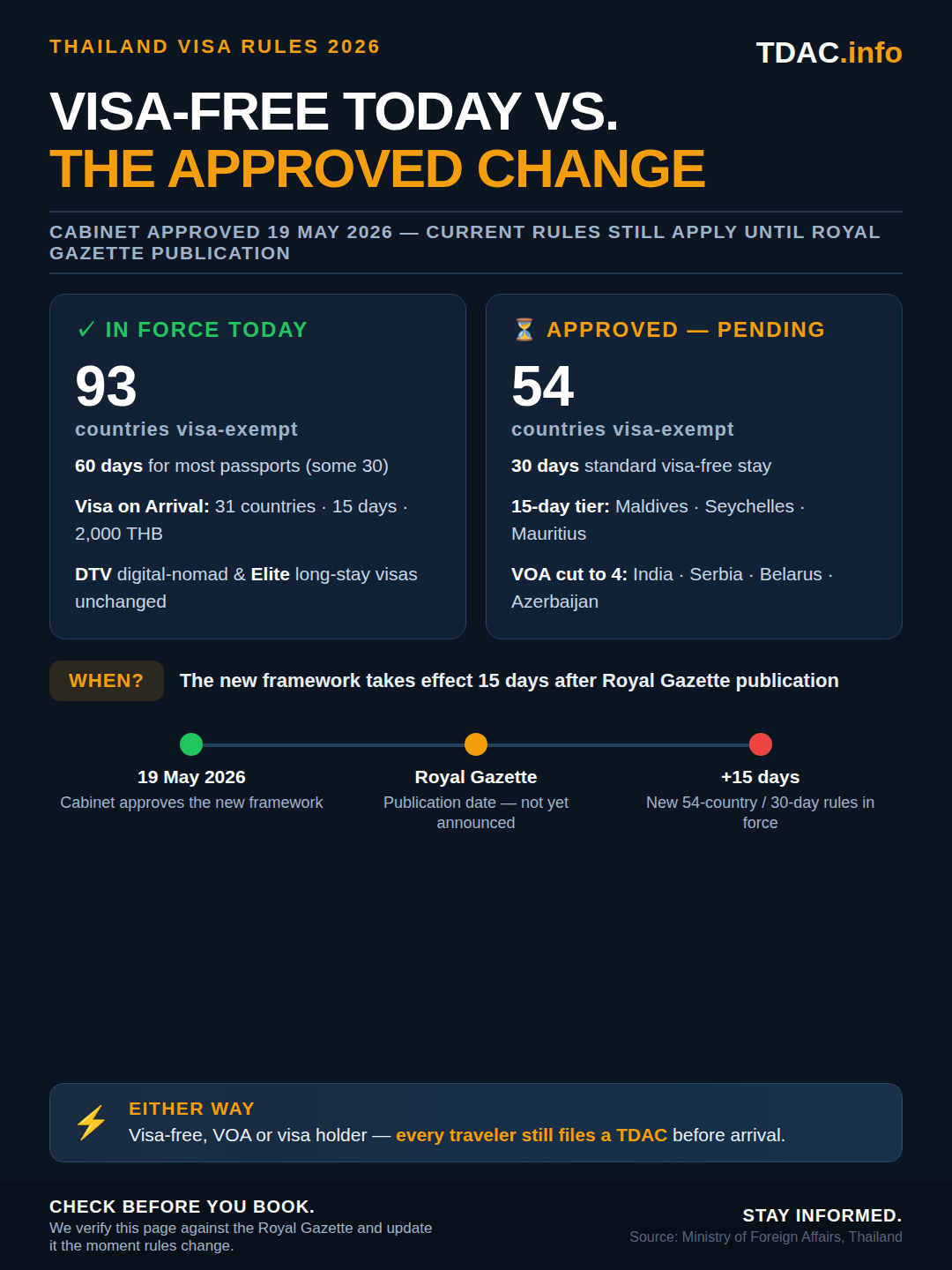
Thailand's visa-exemption framework was rewritten in the Royal Gazette on 31 August 2026 and the new rules took effect on 15 September 2026. The 60-day exemption granted to 93 countries in July 2024 is cancelled. In its place, 60 countries and territories get a 30-day visa exemption, Seychelles and Mauritius get 15 days, and three countries have moved to visa on arrival. Every nationality dropped from the list falls back to whatever bilateral agreement it already holds with Thailand, or needs a visa. Below is every category in the new framework, plus tourist visas, the DTV digital nomad visa, Thailand Privilege and the rest. We check this page against the Royal Gazette and date every change.
What changed on 15 September 2026
- Published 31 August 2026: four Interior Ministry regulations in the Royal Gazette, Volume 143, Special Issue 207 Ngor.
- In force since 15 September 2026 (15 days after publication). Travellers who arrived up to and including 14 September 2026 were stamped under the old 60-day rules and keep that stay.
- 60 days is gone for everyone except the handful of countries with a longer bilateral agreement.
- 60 countries and territories keep a visa exemption, now 30 days; Seychelles and Mauritius get 15 days.
- Visa on Arrival shrinks from 31 countries to three — Azerbaijan, Belarus and Serbia.
- Already in Thailand on a 60-day stamp? You keep the stay written in your passport — nobody was cut short retroactively.
Quick summary
- BEFORE 15 SEPTEMBER 2026: 93 countries were visa-exempt, most for 60 days
- SINCE 15 SEPTEMBER 2026: 60 countries and territories are visa-exempt for 30 days
- New 15-day tier: Seychelles and Mauritius
- Visa on Arrival is cut to three countries only: Azerbaijan, Belarus and Serbia (15 days, 2,000 THB)
- Countries dropped from the list fall back to their bilateral agreement, or need a visa
- One extension of up to 30 days at immigration (1,900 THB) is unchanged
- Land-border visa-exempt entries stay capped at 2 per calendar year — Malaysia, Brunei, Indonesia and Singapore are exempt from the cap
- The exemption now covers tourism only — the earlier wording that also allowed short-term business was dropped
- Everyone still completes the Thailand Digital Arrival Card (TDAC), whatever their visa status
VISA RULES AT A GLANCE
Visa-Exempt Countries — 30 Days (from 15 September 2026)
Since 15 September 2026 citizens of the following 60 countries and territories can enter Thailand without a visa and stay up to 30 days. One extension of up to 30 more days is available at any Immigration office for 1,900 THB. Until 14 September 2026 these same nationalities received the old 60-day stamp.
| Country | Duration | Notes |
|---|---|---|
| 🇦🇺 Australia | 30 days | Extendable +30 days |
| 🇦🇹 Austria | 30 days | Extendable +30 days |
| 🇧🇭 Bahrain | 30 days | Extendable +30 days |
| 🇧🇪 Belgium | 30 days | Extendable +30 days |
| 🇧🇹 Bhutan | 30 days | Extendable +30 days |
| 🇧🇳 Brunei | 30 days | Extendable +30 days; exempt from the land-border cap |
| 🇧🇬 Bulgaria | 30 days | Extendable +30 days |
| 🇨🇦 Canada | 30 days | Extendable +30 days |
| 🇭🇷 Croatia | 30 days | Extendable +30 days |
| 🇨🇾 Cyprus | 30 days | Extendable +30 days |
| 🇨🇿 Czech Republic | 30 days | Extendable +30 days |
| 🇩🇰 Denmark | 30 days | Extendable +30 days |
| 🇪🇪 Estonia | 30 days | Extendable +30 days |
| 🇫🇯 Fiji | 30 days | Extendable +30 days |
| 🇫🇮 Finland | 30 days | Extendable +30 days |
| 🇫🇷 France | 30 days | Extendable +30 days |
| 🇬🇪 Georgia | 30 days | Extendable +30 days |
| 🇩🇪 Germany | 30 days | Extendable +30 days |
| 🇬🇷 Greece | 30 days | Extendable +30 days |
| 🇭🇺 Hungary | 30 days | Extendable +30 days |
| 🇮🇸 Iceland | 30 days | Extendable +30 days |
| 🇮🇳 India | 30 days | Extendable +30 days |
| 🇮🇩 Indonesia | 30 days | Extendable +30 days; exempt from the land-border cap |
| 🇮🇪 Ireland | 30 days | Extendable +30 days |
| 🇮🇱 Israel | 30 days | Extendable +30 days |
| 🇮🇹 Italy | 30 days | Extendable +30 days |
| 🇯🇵 Japan | 30 days | Extendable +30 days |
| 🇯🇴 Jordan | 30 days | Extendable +30 days |
| 🇰🇼 Kuwait | 30 days | Extendable +30 days |
| 🇰🇬 Kyrgyzstan | 30 days | Extendable +30 days |
| 🇱🇻 Latvia | 30 days | Extendable +30 days |
| 🇱🇮 Liechtenstein | 30 days | Extendable +30 days |
| 🇱🇹 Lithuania | 30 days | Extendable +30 days |
| 🇱🇺 Luxembourg | 30 days | Extendable +30 days |
| 🇲🇾 Malaysia | 30 days | Extendable +30 days; exempt from the land-border cap |
| 🇲🇻 Maldives | 30 days | Extendable +30 days |
| 🇲🇹 Malta | 30 days | Extendable +30 days |
| 🇳🇱 Netherlands | 30 days | Extendable +30 days |
| 🇳🇿 New Zealand | 30 days | Extendable +30 days |
| 🇳🇴 Norway | 30 days | Extendable +30 days |
| 🇴🇲 Oman | 30 days | Extendable +30 days |
| 🇵🇭 Philippines | 30 days | Extendable +30 days |
| 🇵🇱 Poland | 30 days | Extendable +30 days |
| 🇵🇹 Portugal | 30 days | Extendable +30 days |
| 🇶🇦 Qatar | 30 days | Extendable +30 days |
| 🇷🇴 Romania | 30 days | Extendable +30 days |
| 🇸🇦 Saudi Arabia | 30 days | Extendable +30 days |
| 🇸🇬 Singapore | 30 days | Extendable +30 days; exempt from the land-border cap |
| 🇸🇰 Slovakia | 30 days | Extendable +30 days |
| 🇸🇮 Slovenia | 30 days | Extendable +30 days |
| 🇿🇦 South Africa | 30 days | Extendable +30 days |
| 🇪🇸 Spain | 30 days | Extendable +30 days |
| 🇸🇪 Sweden | 30 days | Extendable +30 days |
| 🇨🇭 Switzerland | 30 days | Extendable +30 days |
| 🇹🇼 Taiwan | 30 days | Extendable +30 days |
| 🇹🇷 Turkey | 30 days | Extendable +30 days |
| 🇺🇦 Ukraine | 30 days | Extendable +30 days |
| 🇦🇪 United Arab Emirates | 30 days | Extendable +30 days |
| 🇬🇧 United Kingdom | 30 days | Extendable +30 days |
| 🇺🇸 United States | 30 days | Extendable +30 days |
Longer Bilateral Agreements — 90 Days
A small number of countries hold a standing bilateral agreement with Thailand granting 90 visa-free days. Under the one country, one privilege principle the more generous of the two rules applies, so these agreements are not affected by the 31 August 2026 gazette.
| Country | Duration | Notes |
|---|---|---|
| 🇦🇷 Argentina | 90 days | Bilateral agreement — unchanged |
| 🇧🇷 Brazil | 90 days | Bilateral agreement — unchanged |
| 🇨🇱 Chile | 90 days | Bilateral agreement — unchanged |
| 🇰🇷 South Korea | 90 days | Bilateral agreement — unchanged |
| 🇵🇪 Peru | 90 days | Bilateral agreement — unchanged |
Dropped From the Exemption List — What Applies Instead
These nationalities were on the 93-country list but are not on the new 60-country list. From 15 September 2026 they fall back to the bilateral agreement their country already holds with Thailand — the one country, one privilege principle — and where no agreement exists, a visa or e-Visa is required. Check the row for your passport before you book.
| Country | From 15 Sep 2026 | What applies instead |
|---|---|---|
| 🇦🇷 Argentina | 90 days | 90-day bilateral agreement — unchanged |
| 🇧🇷 Brazil | 90 days | 90-day bilateral agreement — unchanged |
| 🇨🇱 Chile | 90 days | 90-day bilateral agreement — unchanged |
| 🇰🇷 South Korea | 90 days | 90-day bilateral agreement — unchanged |
| 🇵🇪 Peru | 90 days | 90-day bilateral agreement — unchanged |
| 🇨🇳 China | 30 days | 30-day bilateral agreement, max 90 days per 180 |
| 🇭🇰 Hong Kong | 30 days | 30-day bilateral agreement, SAR passport only |
| 🇰🇿 Kazakhstan | 30 days | 30-day bilateral agreement, max 90 days per 180 |
| 🇱🇦 Laos | 30 days | 30-day bilateral agreement |
| 🇲🇴 Macau | 30 days | 30-day bilateral agreement, SAR passport only |
| 🇲🇳 Mongolia | 30 days | 30-day bilateral agreement |
| 🇷🇺 Russia | 30 days | 30-day bilateral agreement |
| 🇹🇱 Timor-Leste | 30 days | 30-day bilateral agreement |
| 🇻🇳 Vietnam | 30 days | 30-day bilateral agreement |
| 🇰🇭 Cambodia | Visa required | Confirm with the Thai embassy before booking |
| 🇲🇲 Myanmar | 14 days | 14-day bilateral agreement, international airports only |
| 🇲🇺 Mauritius | 15 days | New 15-day visa-exemption tier |
| 🇸🇨 Seychelles | 15 days | New 15-day visa-exemption tier |
| 🇦🇿 Azerbaijan | Visa required | Visa on arrival (15 days, 2,000 THB) |
| 🇧🇾 Belarus | Visa required | Visa on arrival (15 days, 2,000 THB) |
| 🇷🇸 Serbia | Visa required | Visa on arrival (15 days, 2,000 THB) |
| 🇦🇩 Andorra | Visa required | Visa or e-Visa required — apply before you fly |
| 🇨🇴 Colombia | Visa required | Visa or e-Visa required — apply before you fly |
| 🇲🇽 Mexico | Visa required | Visa or e-Visa required — apply before you fly |
| 🇲🇨 Monaco | Visa required | Visa or e-Visa required — apply before you fly |
| 🇲🇦 Morocco | Visa required | Visa or e-Visa required — apply before you fly |
| 🇵🇦 Panama | Visa required | Visa or e-Visa required — apply before you fly |
| 🇸🇲 San Marino | Visa required | Visa or e-Visa required — apply before you fly |
| 🇱🇰 Sri Lanka | Visa required | Visa or e-Visa required — apply before you fly |
| 🇺🇾 Uruguay | Visa required | Visa or e-Visa required — apply before you fly |
| 🇺🇿 Uzbekistan | Visa required | Visa or e-Visa required — apply before you fly |
Visa on Arrival (VOA) — 15 Days
From 15 September 2026 the Visa on Arrival scheme is cut from 31 countries to three: Azerbaijan, Belarus and Serbia. The fee is 2,000 THB in cash, the maximum stay is 15 days and it cannot be extended. India leaves the VOA list and moves up to the 30-day visa exemption. Every other nationality that used visa on arrival must now rely on a bilateral agreement where one exists, or apply for a visa through the Thai e-Visa system before travelling.
VOA Requirements
- Passport valid for at least 30 days
- One recent passport photo (4×6 cm)
- Proof of accommodation (hotel booking)
- Confirmed return ticket within 15 days
- Proof of funds: 10,000 THB per person or 20,000 THB per family
- Completed TDAC (Thailand Digital Arrival Card)
| Country | Duration | Fee |
|---|---|---|
| 🇦🇿 Azerbaijan | 15 days | 2,000 THB |
| 🇧🇾 Belarus | 15 days | 2,000 THB |
| 🇷🇸 Serbia | 15 days | 2,000 THB |
Tourist Visa (TR) — For Longer Stays
If you’re not from a visa-exempt country, or you want a longer stay, the Tourist Visa (TR) is the standard option. Apply via the Thai e-Visa portal (thaievisa.go.th) before travel.
| Type | Duration | Fee | Notes |
|---|---|---|---|
| Single-Entry TR | 60 days | 1,000 THB | Valid 3 months from issue, extendable +30 days |
| Multiple-Entry TR (METV) | 60 days/entry | 5,000 THB | Valid 6 months, max 180 days total |
Tourist Visa Requirements
- Passport valid for at least 6 months
- Completed e-Visa application on thaievisa.go.th
- Recent passport photo
- Proof of accommodation for entire stay
- Return/onward flight ticket
- Proof of funds (20,000 THB per person)
- Processing time: 3–10 business days
Non-Immigrant Visa B — Business & Work
The Non-Immigrant B visa is required for anyone working legally in Thailand or conducting active business. It does not authorize work on its own — you also need a work permit from the Ministry of Labour.
| Type | Duration | Fee | Notes |
|---|---|---|---|
| Single-Entry Non-B | 90 days | 2,000 THB | Must apply for work permit within 15 days of arrival |
| Multiple-Entry Non-B | 1 year | 5,000 THB | 90 days per entry, renewable annually with work permit |
Employer requirements: minimum 2 million THB registered capital per foreign employee (1 million if married to a Thai national). Processing: 5–10 business days.
Destination Thailand Visa (DTV) — Digital Nomads
Launched July 2024, the DTV is Thailand’s answer to the digital nomad movement. It’s a 5-year multiple-entry visa that allows stays of up to 180 days per entry, extendable by another 180 days.
Visa Details
DTV Overview
Fee: 10,000 THB. Valid for 5 years with multiple entries. Each entry allows 180 days, extendable once for another 180 days. Must apply from outside Thailand via thaievisa.go.th.
Who Qualifies
Eligibility
Remote workers employed by non-Thai companies, freelancers, and their legal dependents (spouse and children under 20). Also covers 'Thai Soft Power' participants: Muay Thai, Thai cooking, medical treatment.
Financial Requirements
Proof of Funds
500,000 THB in a bank account, held for at least 90 consecutive days before application. Embassies now strictly enforce this requirement.
Key Restrictions
What to Know
No work permit included — you may only work remotely for overseas employers. Max 2 visa runs per calendar year (since Nov 2025). Language schools no longer qualify as 'Soft Power' activities.
Thailand Privilege (Elite) Visa
Formerly known as the Thailand Elite Visa, the Thailand Privilege Visa is a premium membership program offering guaranteed long-term residency from 5 to 20 years. All tiers include multiple-entry visas, fast-track immigration, and personal liaison services.
| Tier | Price (THB) | Duration | Key Benefits |
|---|---|---|---|
| Bronze | 650,000 | 5 years | Basic long-term stay, fast-track immigration |
| Gold | 900,000 | 5 years | 20 privilege points/year for lifestyle perks |
| Platinum | 1,500,000 | 10 years | 35 points/year, family additions at 500,000 THB each |
| Diamond | 2,500,000 | 15 years | 55 points/year, family additions at 500,000 THB each |
| Reserve | 5,000,000 | 20 years | 120 points/year, maximum exclusivity (invitation only) |
Privilege points can be redeemed for airport transfers, health checkups, golf, spa treatments, and lounge access through a dedicated mobile app. All tiers include Thai bank account opening support and 90-day reporting assistance.
Retirement Visa (Non-O-A) — Age 50+
The Non-Immigrant O-A visa is Thailand’s long-stay option for retirees aged 50 and older. It’s a 1-year multiple-entry visa, renewable annually from within Thailand.
50 years or older
65,000 THB/month or 800,000 THB in Thai bank
Health insurance with min. 40,000 THB inpatient + 400,000 THB outpatient
1 year, renewable annually
Required every 90 days at immigration
Education Visa (Non-ED)
The Education Visa is for students enrolled in Thai language schools, universities, or accredited training programs. Valid for the duration of your course, with 90-day reporting required.
ED Visa Requirements
- Acceptance letter from an accredited Thai institution
- Passport valid for at least 6 months
- Proof of funds (sufficient for duration of study)
- Course must be at least 6 months for DTV soft-power consideration
- Note: Language schools no longer qualify for DTV — use ED visa instead
The 300-Baht Tourist Entry Fee
Thailand has approved a 300-baht entry fee for foreign tourists, but it is not being collected yet. Originally slated for February 2026, the launch has slipped repeatedly — officials have pointed to the second half of 2026 — and the collection mechanism has still not been announced. You do not pay anything today, and no traveller should be asked for it at the border.
As approved, the fee applies to arrivals by air only. An earlier proposal to charge 150 baht at land and sea crossings was shelved. Of the 300 baht, 70 baht funds medical and accident insurance that covers you from the moment you enter Thailand, with the balance going to tourism infrastructure and visitor safety. It is expected to be bundled into airfare rather than collected at the airport.
What this means for your trip
- Nothing to pay right now — the fee is approved but not in force
- Air arrivals only; the land and sea charge was dropped
- 70 of the 300 baht buys you medical and accident cover, valid from entry
- Separate from the TDAC, which is free to file and mandatory either way
- We monitor the rollout and update this section when a collection date is confirmed
Frequently Asked Questions
Do I have to pay the 300-baht tourist entry fee?
Do I need a visa for Thailand?
What’s the difference between visa-exempt and visa on arrival?
Can I extend my stay in Thailand?
Do I still need to fill out the TDAC if I’m visa-exempt?
What happens if I overstay my visa?
Can I do a visa run to extend my stay?
Which visa is best for digital nomads?
How much does the Thailand Elite visa cost?
Flying to Thailand soon?
All visitors must complete the Thailand Digital Arrival Card before arrival — regardless of visa type. Our expert team reviews your application for errors and delivers your QR code instantly.
Start TDAC Application