Published in the Royal Gazette on 31 August 2026
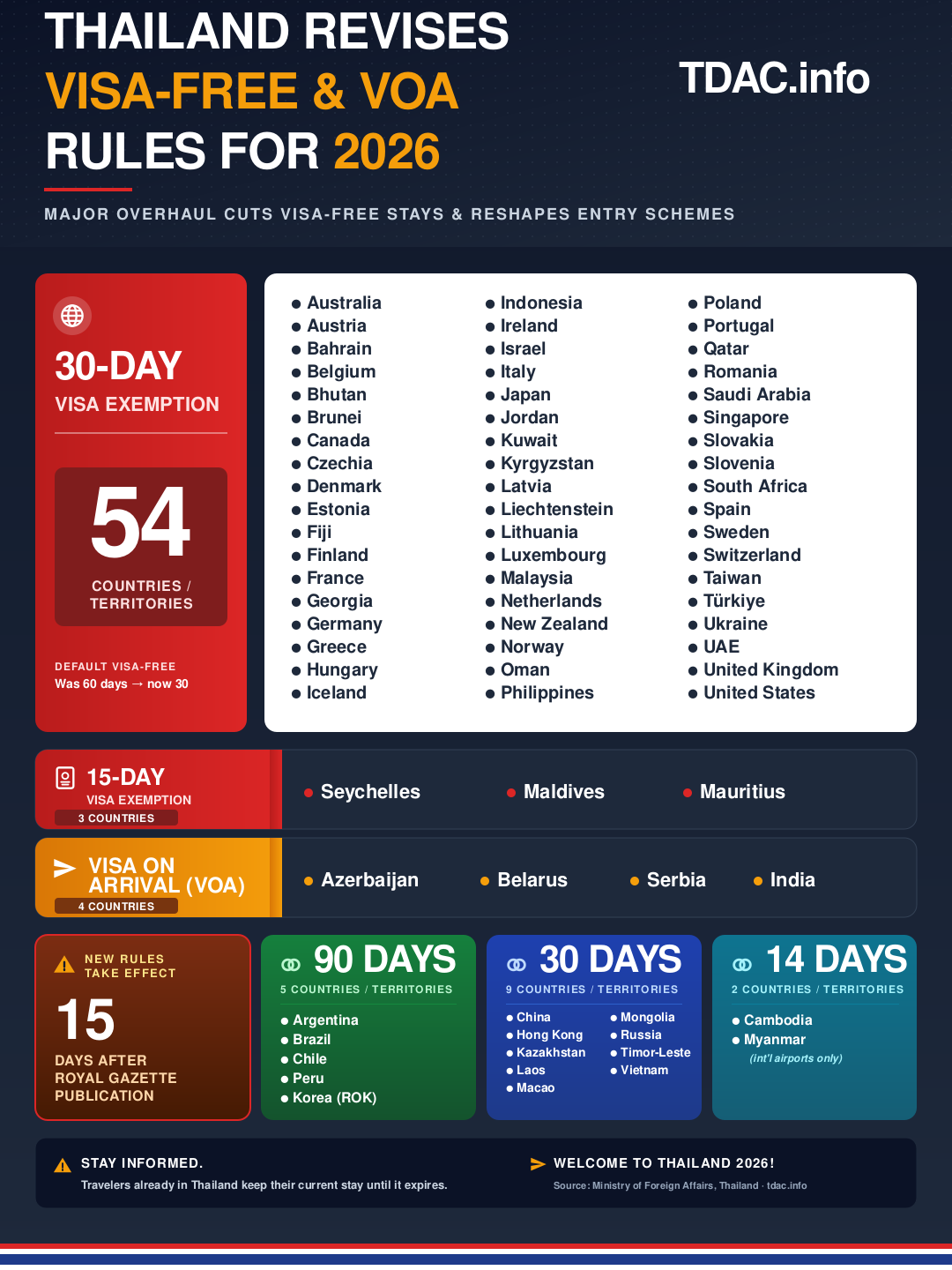
The change is law. Four Interior Ministry regulations were published in the Royal Gazette on 31 August 2026 (Volume 143, Special Issue 207 Ngor) and took effect 15 days later, on 15 September 2026. The 60-day visa exemption of July 2024 is cancelled; 60 countries and territories receive 30 days, Seychelles and Mauritius receive 15, and Azerbaijan, Belarus and Serbia moved to visa on arrival. Travellers who arrived up to and including 14 September 2026 were stamped under the old rules and keep that stay.
This is the largest reversal of Thailand's tourist entry policy in nearly two years. The 60-day visa exemption introduced in July 2024 was widely treated as permanent; it lasted 26 months. On 19 May 2026 the Cabinet approved scrapping it, and on 31 August 2026 the Royal Gazette turned that decision into law. From 15 September 2026 the default visa-free stay is 30 days, the exemption list shrinks from 93 countries to 60, and the practical maximum stay without a visa falls from 90 days to 60.
WHAT CHANGES
60 days visa-free + 30-day extension = 90 days total
30 days visa-free + 30-day extension = 60 days total
~93 visa-exempt nationalities
May be reclassified to 15 days
Pending Royal Gazette publication
Unchanged - still mandatory
What the Royal Gazette Actually Says
The rollback began as a Cabinet resolution on 19 May 2026, which Tourism and Sports Minister Surasak Phancharoenworakul framed as a focus on quality tourists, not simply on making entry easy. It was driven by the Ministry of Foreign Affairs under Deputy Prime Minister and Foreign Minister Sihasak Phuangketkeow. What was a resolution then is now law: four Ministry of Interior notifications, published in the Royal Gazette on 31 August 2026 and effective 15 September 2026.
The notifications repeal the 60-day exemption that roughly 93 countries had held since 15 July 2024 and replace it with a 30-day exemption for 60 countries and territories. Seychelles and Mauritius go into a new 15-day tier. Visa on Arrival is cut from 31 countries to three — Azerbaijan, Belarus and Serbia — while India moves the other way, off visa on arrival and onto the 30-day exemption. The exemption now covers tourism only.
| Item | Until 14 Sep 2026 | From 15 Sep 2026 |
|---|---|---|
| Default visa-free stay | 60 days | 30 days |
| Maximum stay without a visa | 90 days | 60 days |
| Eligible country list | 93 countries | 60 countries and territories |
| Shortest exemption tier | None | 15 days for Seychelles and Mauritius |
| Visa on Arrival | 31 countries | 3 countries: Azerbaijan, Belarus, Serbia |
| Purpose covered | Tourism and short business | Tourism only |
| Land border entries per year (visa-free) | Up to 2 | Up to 2; Malaysia, Brunei, Indonesia and Singapore exempt |
| TDAC requirement | Mandatory for all arrivals | Mandatory for all arrivals (unchanged) |
Who gets what from 15 September 2026
30 days visa-free — 60 countries and territories (60)
- Australia
- Austria
- Bahrain
- Belgium
- Bhutan
- Brunei
- Bulgaria
- Canada
- Croatia
- Cyprus
- Czechia
- Denmark
- Estonia
- Fiji
- Finland
- France
- Georgia
- Germany
- Greece
- Hungary
- Iceland
- India
- Indonesia
- Ireland
- Israel
- Italy
- Japan
- Jordan
- Kuwait
- Kyrgyzstan
- Latvia
- Liechtenstein
- Lithuania
- Luxembourg
- Malaysia
- Maldives
- Malta
- Netherlands
- New Zealand
- Norway
- Oman
- Philippines
- Poland
- Portugal
- Qatar
- Romania
- Saudi Arabia
- Singapore
- Slovakia
- Slovenia
- South Africa
- Spain
- Sweden
- Switzerland
- Taiwan
- Türkiye
- Ukraine
- United Arab Emirates
- United Kingdom
- United States
15 days visa-free — new tier (2)
- Mauritius
- Seychelles
Visa on arrival — 15 days, 2,000 THB, not extendable (3)
- Azerbaijan
- Belarus
- Serbia
Why Thailand Is Doing This
Officials gave three overlapping reasons. None of them are about ordinary tourists, but ordinary tourists are the ones who absorb the change.
- Visa misuse: The Ministry of Foreign Affairs said the 60-day window has increasingly been exploited by individuals entering as tourists while operating nominee businesses, working without permits, or running call-center fraud operations. Reducing the default stay shortens that runway.
- Average stay is much shorter than 60 days: Government data cited in the briefing showed the average foreign visitor stays around 9 days. Officials argued the 60-day default was generous well beyond what tourism actually requires.
- Security and economic screening: Each visa-exempt country will now be re-evaluated by the Visa Policy Committee against both security and economic criteria, opening the door to differentiated treatment by nationality.
What Is Still Unclear
Detail the Thai government has not published yet
The framework itself is settled — the dates, the country lists and the tiers are all in the Royal Gazette. The items below are operational details that have not been spelled out, and we will update this page as soon as they are.
- Changeover day. The notifications took effect on 15 September 2026. Travellers who landed on or before 14 September 2026 kept the 60-day stamp they were given; everyone landing from 15 September gets 30 days.
- Extension policy for the 15-day tier. Seychelles and Mauritius are in a new category and the Immigration Bureau has not confirmed whether the usual 30-day extension is open to them.
- How tourism-only will be enforced. The exemption no longer mentions short business visits, but no guidance has been issued on what counts as a business purpose at the counter.
- Future reclassification. The Visa Policy Committee reviews country status against security and economic criteria, so the 60-country list can change again without a new Cabinet decision.
What This Means for Your Trip
The rules that apply to you are the ones in force on the day you land, not on the day you booked. Since 15 September 2026 that means 30 days for the 60 exempt nationalities; travellers who arrived on or before 14 September 2026 keep the 60-day stamp they were given. There is no need to cancel trips — the practical impact depends only on how long you intend to stay.
Trips under 30 days - no practical impact
The overwhelming majority of Thailand holidays - long weekends, two-week vacations, three-week tours - fall well inside 30 days. Nothing about your trip changes. File your TDAC, fly in, enjoy.
Trips between 30 and 60 days - plan a 30-day extension
You need to visit a Thai Immigration Bureau office (Chaeng Watthana in Bangkok, or regional offices in Phuket, Chiang Mai, etc.) before day 30, bring 1,900 THB plus a passport photo and TM.7 form, and apply for a 30-day extension. Allow half a day - queues are long in peak season.
Trips longer than 60 days - apply for a proper tourist visa
If you want a stay longer than the new 30+30 maximum, do not try to chain visa runs. Apply for a Tourist Visa (TR) at a Thai embassy before you travel, or look at longer options like the Destination Thailand Visa (DTV) for digital nomads. A proper visa gives you a known stamp and avoids friction at the border.
Check your nationality before you book
Some countries may be reclassified to 15 days rather than 30 once the Visa Policy Committee publishes the country list. If your passport sits in a borderline category, build flexibility into your itinerary.
Your TDAC obligation does not change
Every foreign arrival at participating ports must still complete the Thailand Digital Arrival Card before entry, regardless of visa status or length of stay. File it before you fly.
Not sure which rules apply to your passport?
Use our free Thailand Visa Checker to see your current entry rules, or visit the Thai visa reference for country-by-country details. We will update both as soon as the Royal Gazette publishes the new framework.
How This Fits with Other 2026 Changes
The 60-to-30 day reversal does not sit in isolation. It is part of a wider tightening of Thailand's entry framework that has been rolling out across 2026.
- Land border crackdown: visa-exempt entries by land are capped at 2 per calendar year per traveller, aimed at the visa-run culture in the Malaysian, Cambodian, Lao and Myanmar border towns. From 15 September 2026 citizens of Malaysia, Brunei, Indonesia and Singapore are exempt from that cap.
- Tourism-only exemption: the new notification drops the wording that covered short-term business, narrowing what the visa exemption is for.
- Arrival fee in preparation: a 300 THB landing fee for foreign air arrivals has been approved and is being prepared for rollout, to fund tourism infrastructure and traveller insurance. It is not being collected yet.
- Stricter enforcement at the gate: immigration officers are more frequently asking for onward tickets, 20,000 THB proof of funds and hotel bookings, particularly for solo travellers on one-way tickets.
The combined direction is unambiguous: shorter default stays, fewer eligible countries, more checks at the border, and a clearer distinction between tourists and de-facto residents using visa-free entries to live in Thailand.
Frequently Asked Questions
Is the change in force now?
I am flying to Thailand next week. Do I get 60 or 30 days?
Can I still stay 60 days under the new rules?
My country is not on the new 60-country list. Do I need a visa?
I am already in Thailand on a 60-day stamp. Was I cut short on 15 September?
How we maintain this article
The framework above is taken from the four Ministry of Interior notifications published in the Royal Gazette on 31 August 2026 (Volume 143, Special Issue 207 Ngor), effective 15 September 2026, and from the Ministry of Foreign Affairs list of bilateral visa-exemption treaties. We check this page against the Royal Gazette and date every change. Bookmark it if you are travelling to Thailand in the coming months.
Your TDAC is still required.
Whether the rules give you 15, 30 or 60 days, every traveller to Thailand needs a Thailand Digital Arrival Card before entry. We check every field and send your QR code by email.
Start TDAC ApplicationReviewed by
Jason Hartley
Travel Documentation Specialist · TDAC.info
Last reviewed on
Fact-checked against the official Thai Immigration Bureau guidance.