Thailand doubled its standard visa-free stay from 30 days to 60 in July 2024, and reversed it two years later. The Royal Gazette notification of 31 August 2026 cancelled the 60-day scheme: since 15 September 2026 the standard visa-free stay is 30 days for 60 countries and territories. This page explains which stay you get, what happens if you entered before the change, and how to turn 30 days into 60.
30 VS 60 DAYS
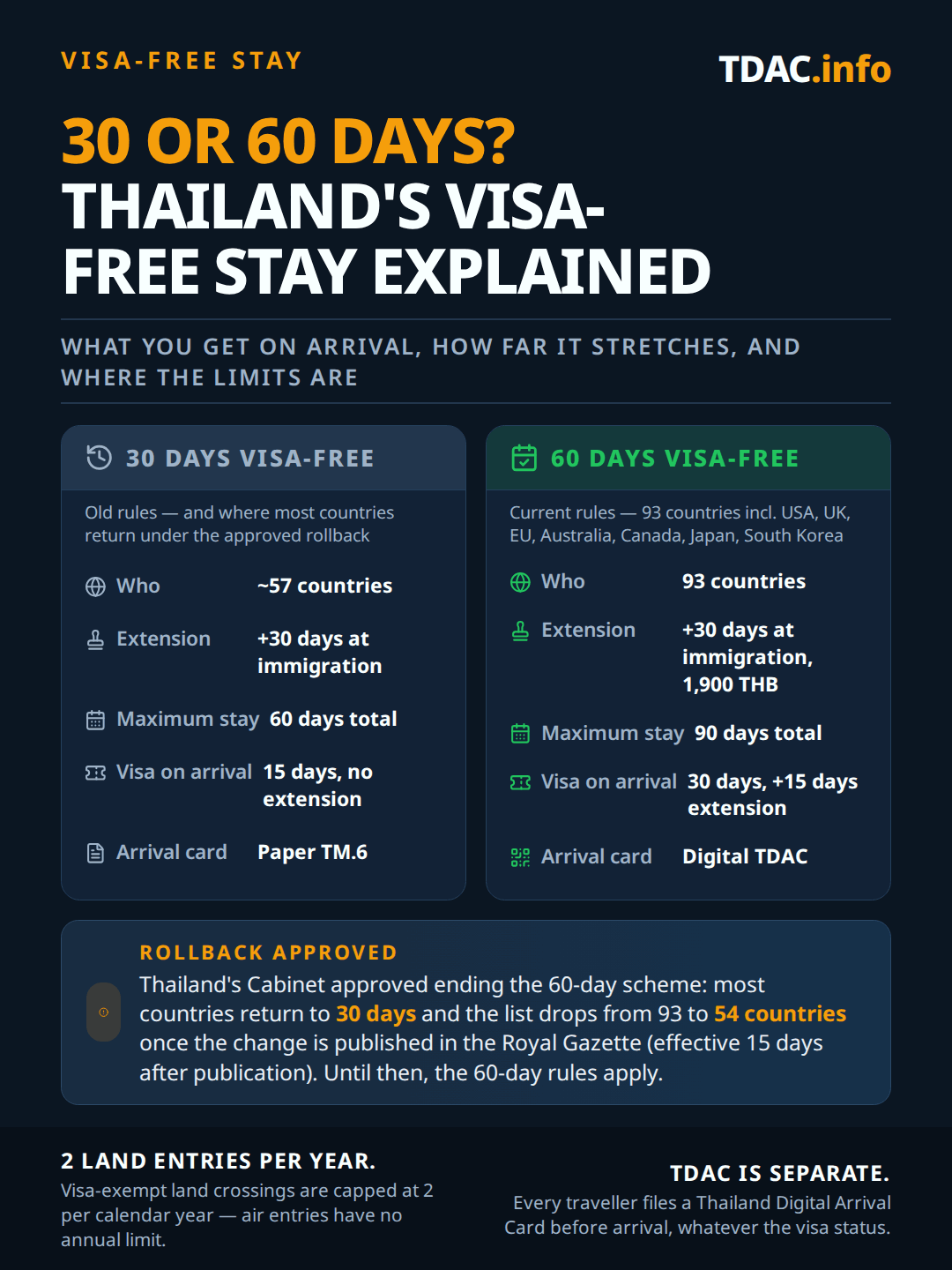
The 60-day scheme ended on 15 September 2026
Published in the Royal Gazette on 31 August 2026, in force since 15 September 2026. If you landed on or before 14 September you were given 60 days and keep them. Everyone who lands on or after 15 September gets 30 days, extendable once by 30 more at any Immigration office for 1,900 THB. Read the Royal Gazette report for the full country list.
Want the full 2026 entry rules?
This page focuses specifically on the 30-day vs 60-day visa-exempt stay. For the complete 2026 entry handbook — passports, proof of onward travel, proof of funds, overstay penalties, and the TDAC requirement — see Thailand Visa & Immigration Rules 2026.
60 days visa-free
30 days visa-free
+30 days (at immigration office)
60 days total without a visa
60 countries and territories
What Changed?
Thailand doubled the standard visa-free stay from 30 to 60 days on 15 July 2024 for citizens of 93 countries, and reversed it 26 months later. The Royal Gazette notification of 31 August 2026 repeals that scheme with effect from 15 September 2026: the default is 30 days again, and the eligible list is cut to 60 countries and territories.
The 30-day exemption applies to 60 countries and territories including the United States, the United Kingdom, all EU member states, Australia, Canada, Japan and India. South Korea is not on the list but keeps 90 days under its bilateral treaty with Thailand.
| Feature | Until 14 Sep 2026 | From 15 Sep 2026 |
|---|---|---|
| Visa-free stay | 60 days | 30 days |
| Extension at immigration | +30 days, 1,900 THB | +30 days, 1,900 THB |
| Maximum stay without a visa | 90 days total | 60 days total |
| Eligible countries | 93 countries | 60 countries and territories |
| Shortest exemption tier | None | 15 days (Seychelles, Mauritius) |
| Visa on Arrival | 31 countries, 15 days | 3 countries, 15 days |
| Purpose covered | Tourism and short business | Tourism only |
| TDAC required | Yes | Yes (unchanged) |
Who Qualifies for 30 Days?
The 30-day exemption applies to passport holders from 60 countries and territories — a cut of 33 from the 93-country list that ran until 14 September 2026. The countries removed include China, Russia, South Korea, Hong Kong, Vietnam, Kazakhstan, Brazil, Argentina and Mexico; most of them keep a bilateral treaty stay instead, and a few now need a visa.
Key Countries With 30-Day Visa-Free Entry
Americas: USA, Canada
Europe: All EU/EEA countries, UK, Switzerland, Ukraine, Georgia
Asia-Pacific: Japan, Taiwan, Australia, New Zealand, Singapore, Malaysia, Indonesia, the Philippines, Brunei, India
Middle East: Israel, UAE, Bahrain, Kuwait, Qatar, Oman, Saudi Arabia, Jordan
Dropped from the list but covered by a bilateral treaty: South Korea, Brazil, Argentina, Chile and Peru at 90 days; China, Hong Kong, Russia, Vietnam, Kazakhstan, Laos, Macau, Mongolia and Timor-Leste at 30. For the full list, see our Thailand visa requirements page.
How to Extend Your Stay
You can extend a 30-day visa-free stay by 30 additional days at any Thai Immigration Bureau office for 1,900 THB — giving you up to 60 days in total without a visa, down from the 90 that was possible until 14 September 2026. Here is how:
Gather Your Documents
You need: your passport (original), one passport-sized photo (4x6 cm), a completed TM.7 application form (available at the office), a photocopy of your passport photo page and entry stamp, and 1,900 THB in cash (the extension fee).
Visit an Immigration Office
Go to the nearest Thai Immigration Bureau. The most popular offices are at Chaeng Watthana (Bangkok), Muang Thong Thani, Phuket Town, or Chiang Mai. Arrive early — queues can be 2–4 hours during peak season.
Submit Your Application
Hand over your documents and fee to the officer. They will review your passport, stamp your extension, and write the new departure date in your passport. The process takes 30 minutes to 2 hours depending on the office.
Receive Your New Stamp
Your passport will be stamped with a new departure date — 30 days from the date of extension (not from your original entry date). You are now legally permitted to stay for up to 90 days total from your original entry.
Important Rules & Limitations
Land border entries are limited to 2 per calendar year, working is prohibited, and you must carry 20,000 THB in cash as proof of funds. Here are all the rules immigration officers enforce strictly from 15 September 2026:
- Air vs. land entry: the 30-day exemption applies to both air and land crossings. Land entries are limited to 2 per calendar year for visa-exempt travellers, except for citizens of Malaysia, Brunei, Indonesia and Singapore, who are exempt from the cap. Air entries have no annual limit.
- Tourism only: from 15 September 2026 the exemption covers tourism, and the earlier wording that also allowed short business meetings was dropped. Working, including remotely for a foreign employer, requires the appropriate visa and a work permit.
- Passport validity: your passport must have at least 6 months of validity remaining from your date of entry. Airlines may deny boarding if it expires sooner.
- Proof of onward travel: you must have a confirmed flight or transport booking leaving Thailand within your permitted stay — 30 days for most exempt nationalities. Immigration officers can and do ask for this.
- Proof of funds: you may be asked to show 20,000 THB ($600 USD) in cash per person. Enforced randomly, more often for solo travellers on one-way tickets.
- TDAC is mandatory: whatever your visa status, you must file a Thailand Digital Arrival Card before arrival. It is separate from the visa exemption.
- Extension is discretionary: the 30-day extension is not guaranteed. Officers can refuse it, though this is very rare for tourists with clean records.
Land Border Limit
If you are a visa-exempt traveller entering by land (from Malaysia, Laos or Myanmar — the Cambodian crossings are currently closed), you are limited to 2 land entries per calendar year. From 15 September 2026 citizens of Malaysia, Brunei, Indonesia and Singapore are exempt from that cap. After your two entries you must fly in or apply for a visa. The rule targets border runners who used visa-exempt entries to live in Thailand indefinitely. Air entries remain unlimited.
What About the TDAC?
The TDAC (Thailand Digital Arrival Card) is a separate requirement from the visa exemption. Every foreign traveler must file a TDAC before arriving in Thailand, regardless of whether they are visa-exempt, hold a visa, or use visa on arrival.
The TDAC collects your passport data, flight information, and Thai accommodation address. It replaced the old paper TM.6 form. Filing takes about 5 minutes and produces a QR code that you present at immigration alongside your passport.
Is the 30-day visa exemption permanent?
Can I still stay 90 days without a visa?
I arrive on 13 September and leave in November. What stay do I get?
Do children get the same 30 days?
I entered by land. Do I get 30 days?
Check your visa status instantly
Use our free Thailand Visa Checker — answer 3 quick questions to find out exactly which visa option is right for you.
Your 30 days start with a TDAC.
Whether you are visiting for a weekend or extending to the full 60 days, every traveller needs a Thailand Digital Arrival Card. File yours in five minutes and we check every field.
Start TDAC ApplicationReviewed by
Jason Hartley
Travel Documentation Specialist · TDAC.info
Last reviewed on
Fact-checked against the official Thai Immigration Bureau guidance.