Download Our Free Arrival Guide
Make a seamless landing in Thailand — print it out and take it with you!
1-sheet guide (2 pages) • English • PDF
Table of Contents
Entering Thailand has evolved. The days of scrambling for a pen on the plane to fill out the blue "TM6" paper card are over. Thailand has transitioned to the Thailand Digital Arrival Card (TDAC), a mandatory electronic system designed to streamline immigration and enhance border security.
Why this matters
Filing your TDAC online allows you to use the "Express Data" lanes at immigration checkpoints. Travelers who wait to file at airport kiosks often face 30-60 minute delays before even reaching the passport control queue.
1. What is the TDAC?
The TDAC (Thailand Digital Arrival Card, often mistyped as TDCA or TDA) is an electronic declaration of your arrival in the Kingdom of Thailand. It collects essential data — your passport details, flight information, Thai accommodation address, and purpose of visit — so that the Immigration Bureau can pre-screen arrivals before you even touch down.
It replaces the traditional TM6 Paper Card. If you visited Thailand before 2020, you likely remember the blue slip stapled into your passport. That paper form was in use for decades, and every arriving passenger had to fill it out by hand on the plane or at the immigration counter.
The TM6-to-Digital Timeline
Thailand's Immigration Bureau began phasing out the paper TM6 in stages. A pilot program started in late 2022 at select airports, followed by a broader rollout through 2023. By mid-2024, the paper form was fully retired for air arrivals at all major international airports. The digital system — officially called the Thailand Digital Arrival Card — is now the sole method of entry declaration for foreign nationals arriving by air.
What Data Does the TDAC Collect?
- Personal identity: Full name (as per passport MRZ), date of birth, nationality, gender, passport number, and passport expiry date.
- Travel details: Flight number, airline, arrival date, and port of entry.
- Accommodation in Thailand: Hotel name and city, or full address for private accommodation.
- Purpose of visit: Tourism, business, medical, transit, etc.
- Contact information: Email address and phone number for digital delivery of your QR confirmation.
How It Connects to Thailand's e-Gate System
When you file your TDAC, your data is matched against your passport's machine-readable zone (MRZ). At the airport, the automated e-Gates read the MRZ chip in your passport and cross-reference it with your TDAC submission. If everything matches, you walk through in seconds. If there is a mismatch — even a single character — the gate rejects you and you are directed to a manual counter, which can add 30 minutes or more to your wait.
Important distinction
The TDAC is NOT a visa. It does not grant you permission to enter Thailand — it is a separate entry declaration form. You still need a valid visa, visa exemption, or visa on arrival depending on your nationality. Check your visa requirements here →
Skip the hassle — let us file for you
Our team files your TDAC with expert error review, instant QR delivery, and 24/7 support. $29 per traveller, refunded if the card is rejected. Takes 5 minutes.
Start Application →THIM app — current status
Thailand's Immigration Bureau is launching a mobile app, THIM (Thailand Immigration Management), that files the same TDAC from your phone: passport scan, up to 10 travellers, about three minutes. Pilot since June 2026, official launch August 2026. It is not a second form — the TDAC web portal and assisted filing continue to work, and immigration checks the same QR code. Details in our THIM update.
2. Who Must File a TDAC?
Every foreign national entering Thailand by air via a major international airport is required to have a TDAC record. This applies regardless of your visa status — whether you are a first-time tourist on visa exemption or a long-term resident returning on a retirement visa.
| Traveler Type | TDAC Required? | Notes |
|---|---|---|
| Visa Exemption (Tourists) | Mandatory | Most common for short stays (up to 30 days from 15 Sep 2026) |
| Visa on Arrival (VOA) | Mandatory | 3 nationalities since 15 September 2026 (Azerbaijan, Belarus, Serbia) — TDAC filed before or at the VOA counter |
| Tourist Visa (TR / METV) | Mandatory | Pre-approved visa sticker in passport |
| Non-Immigrant Visa (B, O, ED, etc.) | Mandatory | Business, retirement, education, marriage visas |
| Long-Term Visa (Elite, LTR, DTV) | Mandatory | Including Thailand Elite and Digital Nomad Visa |
| Diplomatic / Official Passport | Mandatory | Filed through embassy channels in most cases |
| Transit (no immigration clearance) | Not required | Airside transit without entering Thailand |
| Thai Passport Holders | Exempt | Thai nationals use separate immigration lanes |
Visa-Exempt vs. Visa on Arrival vs. Pre-Approved Visa
Travelers often confuse these three categories. Here is the difference:
- Visa Exemption: Since 15 September 2026, citizens of 60 countries and territories (including the US, UK, EU, Australia, Japan and India) can enter Thailand for up to 30 days without a visa, extendable once by 30 more days at immigration. You need a TDAC either way.
- Visa on Arrival (VOA): Since 15 September 2026 only citizens of Azerbaijan, Belarus and Serbia use Visa on Arrival: a 15-day stamp for 2,000 THB paid at the airport. India, once the largest VOA nationality, now enters visa-free for 30 days. The TDAC is required in addition to the VOA application.
- Pre-Approved Visa: If you applied at a Thai consulate and have a visa sticker in your passport, the TDAC is still required — the visa and the arrival card are separate systems.
Not sure about your visa status?
Use our free visa checker tool to find out exactly what you need based on your nationality. It covers all 195 countries and shows requirements for tourism, business, and long stays.
Air Entry vs. Land Border
The digital TDAC system currently applies to air arrivals at major international airports (Suvarnabhumi, Don Mueang, Phuket, Chiang Mai, Krabi, Hat Yai, U-Tapao, and others). Land border crossings and some smaller regional airports may still use paper forms or have separate digital processes. However, the government is actively expanding the digital system to all entry points — check the latest requirements if you are crossing by land from Malaysia, Laos, or Myanmar. Thailand's land borders with Cambodia are currently closed — travel between the two countries is only possible by air.
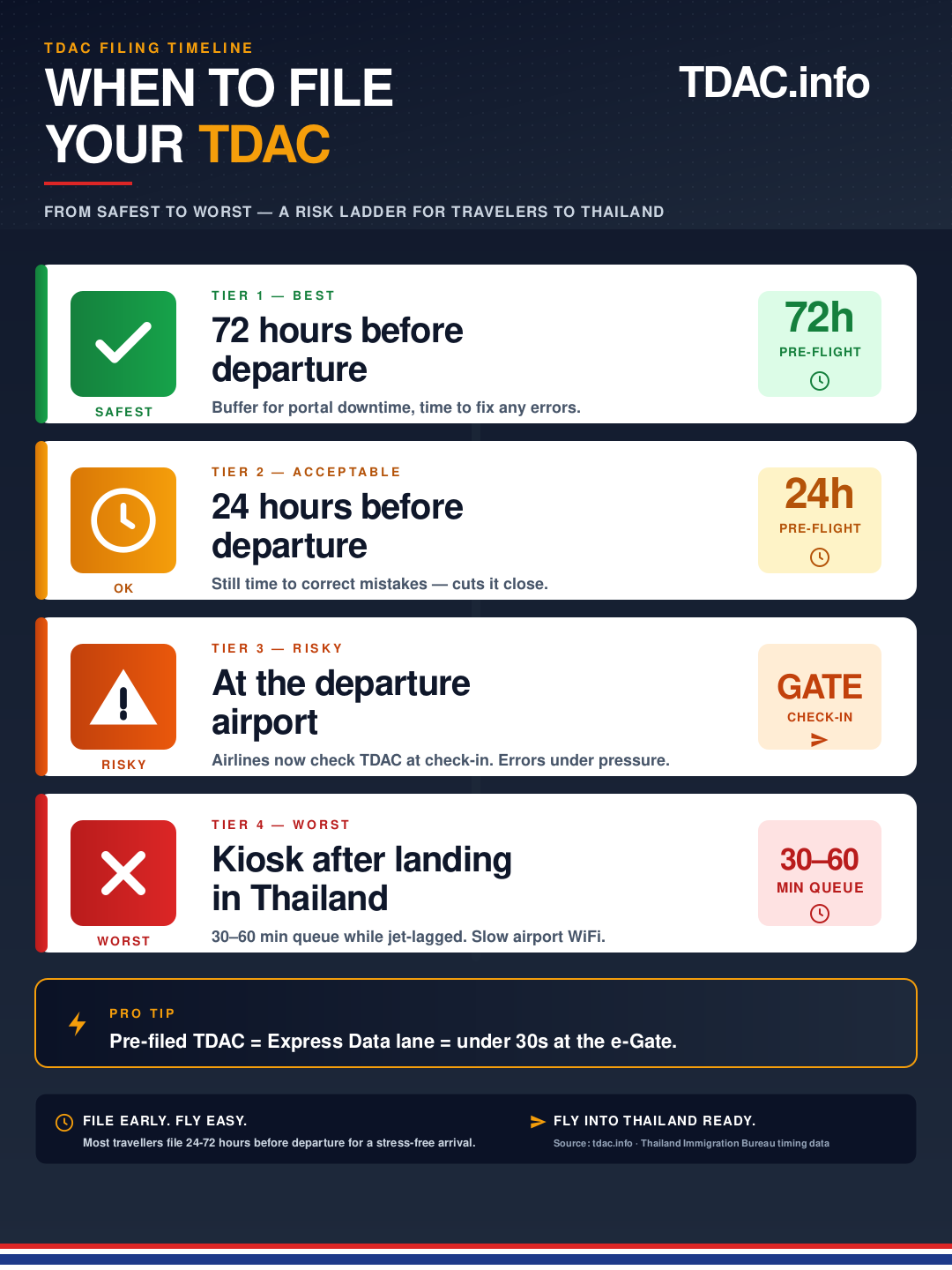
TDAC FILING TIMELINE
3. When to File (Timing Matters)
One of the most common questions we receive is: "When should I fill out the TDAC?" The answer depends on how much risk you are comfortable with.
Best: as soon as the 72-hour window opens (72 hours before arrival)
This gives you ample time to double-check your data, fix any errors, and receive your QR code. If the government system is down for maintenance (it happens), you have a buffer.
Acceptable: 24 hours before departure
Most travelers file the day before. This still leaves time to correct mistakes, but cuts it close if you encounter technical issues.
Risky: At the airport before boarding
Some airlines have started checking TDAC status at check-in. Filing at the departure airport means you are rushing and more likely to make errors under pressure.
Worst: At a kiosk after landing in Thailand
Airport kiosks are available but queues can be 30-60 minutes long. You will be tired from your flight, the WiFi may be slow, and you still have to join the passport control line afterward.
System downtime is real
The official TDAC portal occasionally goes offline for scheduled maintenance, typically between 1:00 AM and 5:00 AM Bangkok time (UTC+7). Unscheduled outages also happen. Do not wait until the last minute. If you file through TDAC.info, we hold your data and submit it the moment the system comes back online — you don't have to worry about timing.
There is no penalty for filing early. Your TDAC is linked to your specific flight and arrival date, so it will be valid when you land regardless of when you submitted it. The only thing that matters is that it is completed before you reach immigration.
4. What You Need Before Starting
Before you sit down to fill out the TDAC, gather these items. Having everything ready will let you complete the form in under 10 minutes without errors.
Valid passport
Must be valid for at least 6 months beyond your entry date. You need at least 1 blank page for the immigration stamp. Check the expiry date — passports expiring within 6 months will be rejected at check-in.
Flight details
Your arriving flight number (e.g., TG670, not your departure leg), airline name, and the date your plane lands in Thailand. Have your booking confirmation email handy.
Thai accommodation address
Hotel name and city, or full street address for Airbnb/condo/hostel. The name must be specific enough to be verifiable — 'a hotel in Bangkok' will not work.
Return or onward ticket information
Immigration may ask for proof of onward travel. While this is not a TDAC field, have it accessible in case of spot checks at the border.
Email address
Your QR code confirmation will be delivered by email. Use an address you can access from your phone at the airport. Avoid work emails that may block external senders.
Passport
Physical document
Photo page must be clean and readable. If the laminate is peeling or the photo is faded, consider renewing before travel.
Flight Booking
Email or app
Airline confirmation with flight number, route, and arrival date. Screenshot it in case you lose internet access.
Hotel Confirmation
Email or app
Booking confirmation showing the property name, full address, and your check-in date. Airbnb confirmations work too.
Travel Insurance
Recommended
Not required for the TDAC, but strongly recommended. Some visa types require proof of insurance covering at least $10,000 USD.
Passport expiry warning
Your passport must be valid for at least 6 months beyond your date of entry into Thailand. If it expires sooner, you will be denied boarding at your origin airport — regardless of your TDAC status, visa, or ticket. This is a Thai Immigration requirement that airlines enforce strictly.
5. Step-by-Step Filing Guide
Filling out the form accurately is critical. A mismatch between your passport's Machine Readable Zone (MRZ) and your TDAC data can cause the automated e-Gates to reject you, sending you to the manual counter where wait times are significantly longer. Below is a detailed walkthrough of each section.
Phase 1: Personal Information
This is where most errors occur. The golden rule: every field must match your passport exactly — not your driver's license, not your credit card, and not your preferred name.
- First Name: Enter your given name exactly as it appears on the passport information page. If your passport shows "JOHN MICHAEL" as the given name, enter both names in the first name field.
- Last Name (Surname): Your family name as shown on the passport. Compound surnames (e.g., "DE LA CRUZ") must include the full surname with spaces.
- Middle Name: Check the MRZ (the two lines of code at the bottom of your passport photo page). If a middle name appears there, include it. If not, leave it blank.
- Passport Number: Copy this character by character. The most common error is confusing the letter 'O' with the digit '0'. When in doubt, the letter is more rounded while the number is narrower.
- Date of Birth: Use the format requested by the system (typically DD/MM/YYYY). This must match the date printed in your passport.
- Nationality: This is the nationality stated in your passport, which may differ from your country of residence. Dual citizens should use the passport they are traveling on.
Correct entry
First Name: JOHN MICHAEL
Both given names from passport
Last Name: SMITH
Matches passport exactly
Passport: AB1234567
Verified against physical document
Date of Birth: 15/03/1990
DD/MM/YYYY format
Common mistakes
First Name: John
Missing middle name from MRZ
Last Name: Smith-Jones
Hyphenated but passport shows SMITH only
Passport: ABI234567
Letter I instead of digit 1
Date of Birth: 03/15/1990
US format MM/DD — will be rejected
Understanding Your Passport MRZ
The MRZ (Machine Readable Zone) is the two lines of characters at the bottom of your passport's photo page. This is what the e-Gates read, and your TDAC data must match it exactly. Here is what a typical MRZ looks like:
PASSPORT MRZ DECODED

Line 1: P<GBRSMITH<<JOHN<MICHAEL<<<<<<<<<<<<<<<<<<<<<
Line 2: AB12345674GBR9003151M2801015<<<<<<<<<<<<<<04
Surname: SMITH (between P<GBR and <<)
Given Names: JOHN MICHAEL (after << separated by <)
Passport No.: AB1234567 (first 9 chars of line 2)
Date of Birth: 900315 = 15 March 1990 (YYMMDD)
Nationality: GBR = United Kingdom
If your passport MRZ shows a middle name, you must include it in your TDAC application. If the MRZ omits your middle name (some countries do this), leave it out of the TDAC as well. The rule is simple: match the MRZ, not your birth certificate.
Phase 2: Travel Details
This section captures your flight information and arrival date. Pay close attention to the details — confusion between departure and arrival data is extremely common.
What flight number do I enter in TDAC?
Enter the flight number of the leg that lands in Thailand — airline code plus digits, exactly as on your booking (e.g., TG670). For connecting itineraries, use the final leg into Thailand, never the first departure.
- Flight Number: Enter the flight number that arrives in Thailand. If you have a connecting itinerary (e.g., London → Dubai → Bangkok), use the Dubai → Bangkok leg. The format is the airline code plus numbers (e.g., TG670, EK384, SQ972).
- Airline: Select or type the operating airline, not the codeshare. If your ticket says "operated by Thai Airways" but was booked through Lufthansa, use Thai Airways.
- Arrival Date: This is the date your plane lands in Thailand, not the date it departs your origin. Many overnight flights cross time zones — a flight departing London at 9 PM on January 15 arrives in Bangkok on January 16. Use January 16.
- Port of Entry: Select the airport where you will clear immigration. The most common are Suvarnabhumi (BKK), Don Mueang (DMK), Phuket (HKT), and Chiang Mai (CNX).
- Transportation Type: Select "Air" for flights. Other options exist for land and sea crossings.
Time zone trap
Bangkok is UTC+7. A flight from Los Angeles (UTC-8) departing at 11:00 PM on March 1 arrives around 5:00 AM on March 3 (not March 2). A flight from London departing at 9:30 PM on March 1 arrives at approximately 3:00 PM on March 2. Always check the arrival date on your booking confirmation, not your departure date.
Phase 3: Accommodation in Thailand
This is the #1 reason applications get flagged for manual review. Immigration wants to know where you are staying, and vague answers trigger extra scrutiny.
- Hotel: Use the full hotel name and city exactly as it appears on your booking. Example: "Grand Hyatt Erawan, Bangkok" or "Centara Grand Beach Resort, Phuket". Do not abbreviate.
- Airbnb / Vacation Rental: Use the full street address including building name or unit number, street, sub-district, and city. Example: "123/45 Sukhumvit Soi 11, Klongtoey Nua, Watthana, Bangkok 10110".
- Hostel: Same as hotel — use the full registered name and city.
- Staying with friends/family: Use the full residential address of where you will stay. Include the building name, floor, and unit number if it is a condo.
- Multiple destinations: Enter the address of your first accommodation in Thailand. You do not need to list every hotel for a multi-city trip.
What NOT to write as your accommodation
Entries like "Bangkok", "hotel", "booking later", or "I don't know yet" will almost certainly flag your application for manual review. Immigration officers see these as red flags. Even if you are genuinely still deciding, pick a hotel now and change your booking later — the TDAC accommodation field is not legally binding, but it must look legitimate.
Phase 4: Review & Submit
Before you hit submit, go through every field one more time. Compare each entry against your physical passport. Once submitted, corrections on the government portal require starting a new application from scratch.
- Verify your name spelling matches the passport MRZ character for character.
- Confirm the arrival date is correct (the day you land, accounting for time zones).
- Confirm the flight number is for the arriving leg, not the departing leg.
- Ensure the passport number has no letter/digit confusion (O vs 0, I vs 1).
- Double-check the accommodation name is specific and verifiable.
After submission, you will receive a confirmation with a QR code via email. This QR code is what you present at immigration. Save it to your phone's photo gallery and print a backup copy. Do not rely solely on opening the email at the airport — WiFi may not be available.
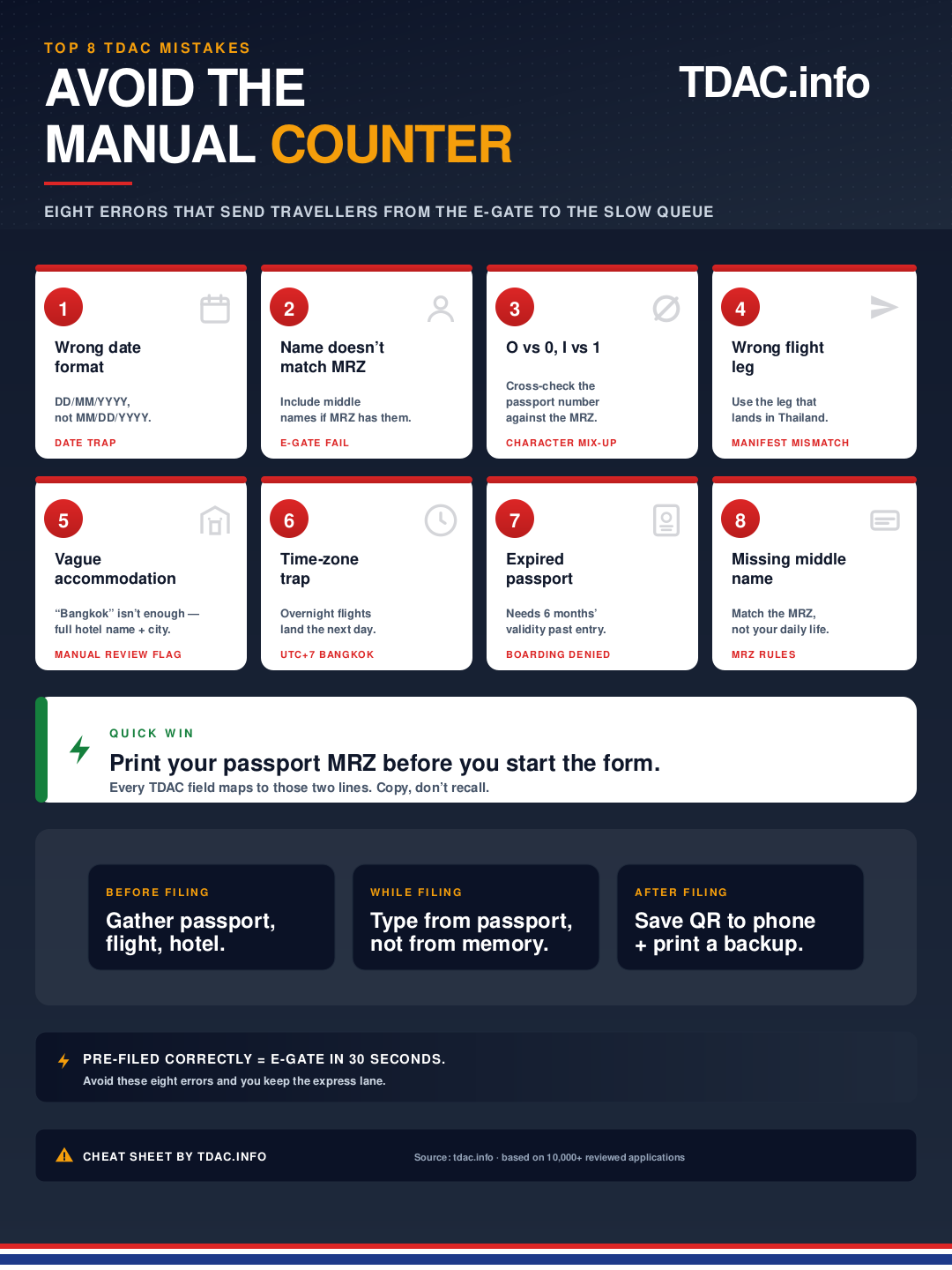
COMMON MISTAKES CHEAT SHEET
6. Common Mistakes & How to Avoid Them
Our agency reviews thousands of TDAC applications every month. Below are the most common errors we encounter — and fix — before they become problems at the border.
Mistake #1: Date format confusion
The TDAC system uses DD/MM/YYYY (Day/Month/Year). North Americans typically write dates as MM/DD/YYYY. This means March 5, 2026 should be entered as 05/03/2026, not 03/05/2026. Entering the wrong format can produce a valid but incorrect date — and you won't see an error message until immigration.
Mistake #2: Name doesn't match passport MRZ
Your name must match the MRZ exactly. If your passport MRZ says "SMITH<<JOHN<MICHAEL", your first name is JOHN MICHAEL (with space), not just "John". Omitting middle names that appear in the MRZ is one of the most common causes of e-Gate rejection.
Mistake #3: Passport number O vs 0
The letter O and the digit 0 look nearly identical in many passport fonts. The same goes for the letter I and the digit 1, or the letter B and the digit 8. Always cross-reference with the MRZ at the bottom of your passport, where the format is standardized.
Mistake #4: Wrong flight number
If your itinerary is London → Singapore → Bangkok, the correct flight number is the Singapore → Bangkok leg. Entering the London → Singapore flight number means your TDAC won't match the airline's manifest for the arriving flight.
Mistake #5: Vague accommodation address
Writing "Bangkok" or "Phuket" as your accommodation is not sufficient. You need a specific, verifiable property name and city. Applications with vague accommodation details are flagged for manual review, adding 15-30 minutes to your immigration processing.
Mistake #6: Wrong arrival date (time zones)
Overnight flights that cross time zones are the most common source of date errors. If your flight departs on March 1 but lands on March 2 in Bangkok, the correct arrival date is March 2. Using your departure date means your TDAC won't align with the immigration records for that day.
Mistake #7: Expired passport (less than 6 months)
Thailand requires at least 6 months of passport validity beyond your entry date. If you arrive on March 15, 2026, your passport must be valid until at least September 15, 2026. Airlines will deny you boarding before you ever reach Thailand.
Mistake #8: Not including the middle name from MRZ
Some travelers have a middle name in their MRZ but never use it in daily life. The e-Gate system doesn't care about your daily life — it reads the MRZ. If the MRZ includes it, the TDAC must include it.
Correct examples
Date of Birth: 15/03/1990
DD/MM/YYYY format
Flight Number: SQ972
Arriving leg: Singapore → Bangkok
Accommodation: Centara Grand, Bangkok
Specific hotel name + city
Arrival Date: 02/03/2026
Date the plane lands in Thailand
Incorrect examples
Date of Birth: 03/15/1990
US format — will be read as 3rd of the 15th month
Flight Number: BA15
London → Singapore leg, not the arriving flight
Accommodation: Bangkok
Too vague — will be flagged
Arrival Date: 01/03/2026
Departure date, not landing date
Don't risk rejection at immigration
Our experts manually review every field against your passport data. We catch errors before they become problems at the border.
Get Expert Review →7. After Filing: What to Expect
You have submitted your TDAC. Now what? Here is the timeline and what to expect at each stage.
Confirmation & QR Code Delivery
After successful submission, you will receive an email containing your TDAC confirmation and QR code. On the government portal, this typically arrives within a few minutes, though it can take up to several hours during peak periods. If you file through TDAC.info, we deliver the QR code to your email within the timeframe shown at checkout — often within minutes for express orders.
How to Save Your QR Code
- Screenshot it — Open the QR code image on your phone and take a screenshot. Save it to your phone's main photo gallery, not buried in a folder.
- Print a copy — This is our #1 recommendation. Airport WiFi can be unreliable, roaming data may not activate immediately, and phone batteries die. A printed QR code eliminates all of these risks.
- Save the email offline — If your email app supports it, mark the confirmation email for offline access so you can open it without internet.
- Share with a travel companion — Send a copy of the QR code to someone traveling with you as a backup.
What If You Need to Make Changes?
On the government portal, there is no edit function after submission. If you discover an error, you must file a new TDAC from scratch. The system will use the most recent submission linked to your passport number.
If you filed through TDAC.info and your flight hasn't departed yet, contact our support team at support@tdac.info. We can make corrections and resubmit on your behalf at no additional cost.
What If You Don't Receive the Email?
- Check Spam/Junk: This is the #1 reason people think they didn't receive their confirmation. Check all spam and junk folders, including Gmail's "Promotions" tab.
- Check the email address: Did you mistype your email when filing? A typo like "gmial.com" instead of "gmail.com" is surprisingly common.
- Wait 30 minutes: During peak travel season, the government system can be slow. Give it at least 30 minutes before taking action.
- Government portal users: There is no support channel for the free government system. You may need to refile from scratch.
- TDAC.info users: Email support@tdac.info or use our live chat. We keep a secure backup of every QR code we generate and can resend immediately.
8. At the Airport: Immigration Walkthrough
You have landed in Thailand. Here is exactly what to expect as you make your way through immigration at each major airport.
Suvarnabhumi Airport (BKK) — Bangkok
Thailand's largest international airport handles over 60 million passengers per year. After your plane arrives, follow these steps:
- Follow "Immigration / Passport Control" signs — After exiting the jet bridge and walking through the terminal corridors, follow the overhead signs. The walk to immigration can take 10-15 minutes depending on your gate.
- Prepare your documents while walking — Passport (open to photo page), boarding pass, and TDAC QR code (on phone screen or printed).
- Choose your lane: Automated e-Gates (faster, if available for your nationality) or manual immigration counters. The e-Gates read your passport chip and match it against your TDAC data.
- e-Gate process: Scan your passport, look at the camera for facial recognition, scan your QR code if prompted. Takes 15-30 seconds if data matches.
- Manual counter process: Hand your passport and QR code to the officer. They will stamp your passport with your permitted stay duration. Takes 1-3 minutes.
- Collect your baggage at the carousel, then proceed through customs (green lane for nothing to declare).
Suvarnabhumi tip
Immigration queues at BKK are longest between 11:00 PM and 2:00 AM (when dozens of long-haul flights from Europe and the Middle East land within a 2-hour window). If your flight arrives during this window, having a pre-filed TDAC and using the e-Gates can save you over an hour.
Phuket International Airport (HKT)
Phuket's international terminal is smaller and the walk to immigration is shorter (5 minutes). However, the immigration hall has fewer counters, so queues can build quickly when multiple flights land close together. The process is the same: passport + QR code at the e-Gate or manual counter. Phuket is a popular VOA destination — if you need a Visa on Arrival, the VOA counter is before the main immigration line.
Chiang Mai International Airport (CNX)
Chiang Mai is the smallest of the three major international airports. Immigration is quick and rarely has long queues except during high season (November–February). The terminal has both e-Gates and manual counters. The same TDAC QR code applies — there is no separate process for regional airports.
e-Gate vs. Manual Counter
The automated e-Gates are faster but not available for all nationalities. As of 2026, e-Gates at Suvarnabhumi and Phuket are open to passport holders from most countries with biometric (chipped) passports. If the e-Gate rejects you — usually due to a data mismatch — you will be directed to a manual counter. This is not a penalty; the officer will simply process you manually.
Documents to Have Ready (In Order)
- Passport — Open to the photo page. Ensure it's easily accessible, not buried in your bag.
- TDAC QR Code — Displayed on your phone screen (brightness turned up) or on a printed sheet.
- Boarding pass — Some officers ask for it, some don't. Have it ready.
- Proof of onward travel — A return ticket or ticket to a third country. Not always checked, but requested in random spot checks.
- Proof of accommodation — Hotel booking confirmation. Again, spot-checked rather than universally required.
- Proof of funds — 20,000 THB cash or equivalent per person (40,000 THB per family). See below.
The "Proof of Funds" rule
Immigration officers perform random spot checks. Tourists entering on visa exemption must be able to show 20,000 THB (approximately $600 USD) in cash or equivalent foreign currency per person, or 40,000 THB per family. Credit cards and bank statements are generally not accepted as proof during these specific spot checks. This rule is enforced sporadically but can result in entry denial if you are checked and cannot produce the funds.
What If Your QR Code Doesn't Scan?
If the e-Gate cannot read your QR code (due to screen glare, a cracked screen, or a corrupted image), don't panic. Simply proceed to a manual immigration counter. The officer can look up your TDAC record using your passport number. Having a printed backup copy eliminates this risk entirely.
Airport-specific guides
For detailed terminal maps, transit tips, and arrival procedures at specific airports, see our dedicated guides: Suvarnabhumi (BKK) · Don Mueang (DMK) · Phuket (HKT) · Chiang Mai (CNX)
9. Special Cases
Not every traveler fits the standard profile. Here are the most common special situations and how they affect your TDAC filing.
Families with Children
Every person entering Thailand needs their own TDAC — including children and infants. There is no "family" filing on the government portal. Each child with their own passport requires a separate application with their own passport details. On TDAC.info, you can add up to 6 passengers (including children) in a single form, and we handle the individual filings for you.
What to Put for Occupation for Children & Infants
The occupation field on TDAC is the most common question for parents. Here is exactly what to select for each age group:
| Age Group | What to Select | Notes |
|---|---|---|
| Infant (0–2 years) | Child | Even if traveling on a parent's lap |
| Toddler / Pre-school (3–5) | Child | Do not select Student |
| School-age child (6–17) | Child | Child is correct even if they attend school |
| University student (18+) | Student | Only for enrolled university/college students |
Important
The occupation field is informational only and will not affect your child's entry into Thailand. However, selecting the correct option avoids unnecessary processing delays. For all minors under 18, always select Child. For every dropdown option explained (retiree, freelancer, homemaker, unemployed), see the complete TDAC occupation list.
Infants with Their Own Passport
If your infant has their own passport (required by most countries for international travel), they need their own TDAC. Use the infant's passport number, not the parent's. For the occupation field, select Child. For the accommodation field, use the same hotel or address as the parent.
Transit Passengers
If you are transiting through a Thai airport without clearing immigration (i.e., you remain airside and your luggage is checked through to your final destination), you do not need a TDAC. However, if you need to exit the transit area to change terminals, collect and recheck luggage, or pass through immigration for any reason, you do need a TDAC.
Land Border Crossings
The digital TDAC system is primarily designed for air arrivals. Land borders between Thailand and Malaysia, Laos, and Myanmar may have different processes. Some land crossings have adopted the digital system, while others still use paper forms. The Thailand–Cambodia land crossings are currently closed to travellers, so that route is not an option regardless of filing method. Check the specific border crossing requirements before you travel. The Thai Immigration Bureau website lists which crossings support digital filing.
Re-Entry After a Day Trip
If you leave Thailand for a day trip (e.g., to Penang, Malaysia or Vientiane, Laos) and return the same day or next day, you need a new TDAC for your re-entry. Each entry into Thailand requires its own TDAC, even if you filed one just days ago. The previous QR code is no longer valid once you exit the country.
Group & Tour Applications
Tour operators and travel agencies can file TDACs on behalf of their clients. If you are part of an organized tour, check with your tour operator — they may handle the TDAC as part of the package. If not, each group member must file individually or use a service like TDAC.info where one person can submit for up to 6 travelers at once.
Business Travelers
Business travelers on Non-Immigrant B visas file the TDAC the same way as tourists. The key difference is in the "Purpose of Visit" field — select "Business" instead of "Tourism". Your accommodation should be a hotel or serviced apartment (not your company's office address). If attending a conference, use your hotel information.
Digital Nomads (DTV Visa Holders)
Holders of Thailand's Destination Thailand Visa (DTV) — the "digital nomad visa" — are required to file a TDAC like all other foreign nationals. Select the appropriate visa type when filing. Your accommodation should be wherever you are staying first — a hotel, co-living space, or rental apartment. Read more about Thailand visa types →
10. DIY vs Professional Filing
You have two options for filing your TDAC: do it yourself on the government portal for free, or use a professional service like TDAC.info. Here is an honest comparison.
TDAC.info Professional Filing
Price: per passenger
Includes expert review
Error Review: Manual review by trained staff
Every field checked against passport
Support: 24/7 email and live chat
Response within 1 hour
QR Delivery: Instant email + secure backup
We resend if lost
Languages: 28 languages supported
File in your native language
Group Filing: Up to 6 passengers in one form
One payment, we handle individual filing
Changes: Free corrections before departure
Contact support to amend
Government Portal (DIY)
Price: Free
No cost
Error Review: None — you are responsible
No validation beyond basic format checks
Support: None
No help desk, no email support
QR Delivery: Email only, no backup
Lost email = start over
Languages: English and Thai only
All fields must be in English
Group Filing: One person at a time
Separate form for each traveler
Changes: No edits — refile from scratch
New application required
When DIY Makes Sense
- You are a solo traveler comfortable with English-language forms.
- You have experience with the TDAC or similar immigration systems (e.g., US ESTA, Australia ETA).
- You are detail-oriented and willing to triple-check every field against your passport MRZ.
- You have plenty of time before departure and are not worried about system downtime.
When Professional Filing Saves Headaches
- You are traveling with family (especially with children — each person needs their own TDAC).
- You are not confident about the date format, passport number, or MRZ matching rules.
- English is not your first language and you want to file in your native language.
- You want peace of mind that an expert has verified your data before you fly.
- You are on a tight schedule and cannot risk system downtime or refiling from scratch.
- You have had issues at immigration before due to form errors.
Applications reviewed by a real person
First-attempt approval rate
Average form completion time
Support via email and live chat
11. Frequently Asked Questions
Can I apply for my whole family at once?
Do I need to print the QR code?
I didn't receive my confirmation email. What do I do?
Can I edit my TDAC after submission?
What if my flight is canceled or rescheduled?
Is the TDAC free on the government website?
How long is the TDAC valid?
Do I need a TDAC if I'm just transiting through Thailand?
What if I'm entering Thailand by land border?
Can I use a screenshot of the QR code instead of the original email?
What's the difference between TDAC and eVisa?
I'm a Thai citizen — do I need to file a TDAC?
Ready to file?
Join travelers from around the world who filed their TDAC through our expert service. 5-minute form, manual error review, instant QR code delivery.
Start Your TDAC Application